As dogs age or develop mobility challenges, everyday activities like climbing stairs can become difficult or even dangerous. Whether your dog is showing signs of discomfort, struggling with balance, or has lost the ability to use their hind legs entirely, there are ways to make stairs safer and more manageable.
At a Glance: Helping a Dog Use Stairs Safely
| Quick Answer | |
|---|---|
| Can senior dogs use stairs? | Yes, many can with proper support and safety modifications. |
| When should stairs be avoided? | After surgery, during IVDD recovery, or if your dog frequently falls. |
| Best mobility aid | A support harness is often the safest first step. |
| Most important home modification | Install non-slip stair treads or carpet runners. |
| When to see a veterinarian | If your dog suddenly struggles with stairs, shows pain, or loses balance. |
If your dog is unable to control their movement on stairs, repeatedly loses balance, or suddenly begins rushing down without being able to slow down, restrict stair access until your veterinarian can assess the cause. A support harness may help some dogs, but it cannot make stairs safe for every mobility condition.
Signs Your Dog Is Struggling on the Stairs
Recognizing when your dog is having trouble with stairs is crucial for preventing injuries. Look for these common signs:
- Hesitation or Avoidance: Your dog may pause at the base of the stairs or refuse to go up or down.
- Slipping or Stumbling: If your dog is losing footing or appears unsteady, it could indicate muscle weakness or joint pain.
- Whining or Panting: Signs of distress or exertion could mean your dog is experiencing pain when using the stairs.
- Using Only the Front Legs: Some dogs rely heavily on their front legs to compensate for weakened hind legs. This may cause your dog to come down the stairs faster than they meant to.
- Lagging Behind or Needing Assistance: If your dog requires your support to navigate stairs or begins moving slowly on the stairs, they may need additional help.
Be observant; many of the signs that your dog is struggling on the stairs are easy to dismiss as signs of aging or even ignored. Watching your dog descend the stairs is a good way to see how in control your dog is. If your dog gets faster and faster as they go down the stairs, they may not have enough leg strength to control the speed at which they descend, and this may be a sign that your dog needs help. If your dog takes one step at a time and pauses in between, they may be aware that their legs are weaker than they used to be and may be a sign that they aren’t confident and need your help on the stairs.
Not every change in stair behavior is caused by leg weakness. Dogs experiencing vision changes may hesitate at the edge of a step, misjudge distances, or become less confident in dim lighting. If your dog seems physically capable of climbing but suddenly appears uncertain about where to place their paws, vision changes are another possibility worth discussing with your veterinarian.
From My Experience: What Your Dog’s Behavior on Stairs Can Tell You
During my years working with dogs experiencing mobility challenges, I often found that changes in how a dog navigated stairs were among the earliest indications that something had changed.
And it wasn’t always about difficulty climbing stairs.
How a dog goes down stairs can be just as revealing as how they go up.
For example, a dog that suddenly rushes down the stairs may not simply be excited to reach the bottom. In some cases, weakening hind legs can make it difficult to control the descent. Instead of moving carefully from one step to the next, the dog may appear to move faster because they are struggling to slow themselves down.
Other changes can be more subtle. A dog may hesitate before taking the first step, move more cautiously than usual, or begin avoiding stairs altogether.
These behaviors can have different causes, including muscle weakness, joint pain, vision changes, or neurological conditions.
The important thing isn’t necessarily how quickly or slowly your dog uses stairs. It’s whether their behavior has changed.
If your dog has always raced down the stairs, that alone doesn’t indicate a mobility problem. But if their movements suddenly become less controlled, they begin stumbling, or they seem unable to slow themselves down, it’s worth paying attention and discussing the change with your veterinarian.
Stairs can reveal difficulties that aren’t yet obvious when a dog walks on level ground.
Should My Dog Keep Using the Stairs?
Not every dog needs to stop using stairs completely. The decision depends on your dog’s strength, balance, diagnosis, and confidence.
| If your dog… | Best Approach |
|---|---|
| Hesitates but climbs safely | Add traction and supervise. |
| Occasionally slips | Use a rear support harness and improve stair traction. |
| Has arthritis | Limit unnecessary trips and provide support. |
| Is recovering from IVDD surgery | Avoid stairs unless specifically approved by your veterinarian. |
| Frequently falls | Restrict stair access and consider alternatives. |
| Has complete rear limb paralysis | Carry safely or use an alternative route whenever possible. |
For larger dogs that cannot be carried safely, consider temporarily relocating their bed, food, water, and other essentials to one level of the home. This can eliminate unnecessary stair trips while you work with your veterinarian or canine rehabilitation specialist to determine a safe mobility plan.
How to Help Your Dog Use the Stairs
There are several ways to support dogs struggling with stairs, ranging from simple modifications to specialized equipment:
1. Provide Traction
- Add non-slip stair treads or rubberized mats to reduce slipping.
- Trim your dog’s nails and paw fur to improve their grip.
- Some pets do well wearing traction socks or boots inside the house to help them keep their grip on the stairs and slippery floors.
2. Use Mobility Aids
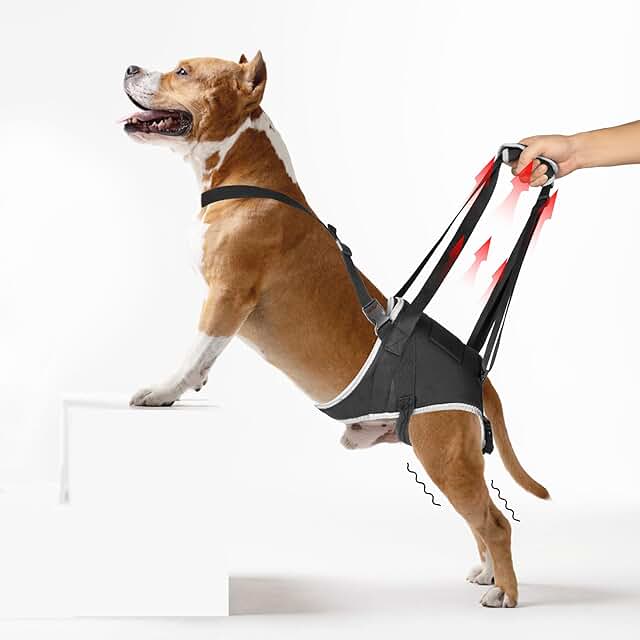
- Lifting harnesses or slings can provide extra support, especially for dogs with weak hind legs. Different harnesses provide different levels of support; make sure to choose one that can be tightly adjusted and has a handle that lets you comfortably lift and support your dog as needed.
- Dog ramps can replace stairs for smaller staircases or decks.
- Stair gates can prevent dogs from attempting stairs when unsupervised.
3. Modify Stair Access
- If stairs are too steep, consider adding a gradual incline ramp.
- Keep stairways well-lit to improve visibility, particularly for senior dogs with vision loss.
- Use a safety gate at the top and bottom of your stairs to prevent your dog from using them without your assistance.
4. Encourage Slow, Safe Movement
- Use treats and positive reinforcement to encourage your dog to take it one step at a time.
- If your dog isn’t quite ready for a lifting harness, walk alongside them for support, ensuring they don’t rush or panic.
Should You Carry Your Dog Up and Down the Stairs?
For some dogs, being carried up or down the stairs is the safest option—but it isn’t always the right solution. Your dog’s size, medical condition, temperament, and your own ability to lift them safely all play a role.
When carrying your dog may be appropriate
You may need to carry your dog if they:
- Are recovering from surgery
- Have Intervertebral Disc Disease (IVDD) and have been prescribed strict rest
- Cannot safely support their own weight
- Have temporary paralysis or severe weakness
- Are a small breed that can be lifted comfortably
- Have been instructed by your veterinarian to avoid using stairs entirely
Whenever possible, support both your dog’s chest and hindquarters to keep the spine aligned and avoid placing unnecessary stress on injured joints.
When carrying may not be the best option
Carrying isn’t practical—or safe—for every dog.
It may be better to use a support harness or ramp if your dog:
- Is too large to lift safely
- Becomes anxious or struggles while being carried
- Has chronic mobility issues requiring long-term assistance
- Is recovering from an injury where twisting the spine could cause additional damage
If lifting your dog puts you at risk of injury, explore other mobility aids instead. A fall on the stairs could injure both you and your dog.

Tip: If you’re unsure whether your dog should continue using stairs, ask your veterinarian or canine rehabilitation specialist. In some cases, avoiding stairs entirely during recovery is the safest choice.
Common Stair-Related Injuries—and How to Prevent Them
Stairs pose a significant injury risk for senior and mobility-impaired dogs, especially when muscle strength, coordination, or vision is compromised. Understanding the most common stair-related injuries can help you take proactive steps to protect your dog.
Slips and Falls:
A sudden slip can lead to bruising, ligament strains, or fractures—particularly in older dogs with brittle bones or arthritis. Non-slip stair treads, adequate lighting, and controlled movement with a harness can drastically reduce fall risk.
Joint Strain and Arthritis Flare-Ups:
Repeated stair climbing puts stress on the hips, knees, and spine. Dogs with arthritis or hip dysplasia may experience increased inflammation and pain after using stairs. Limiting stair use, providing ramps, and using supportive harnesses can reduce joint impact.
Back and Spinal Injuries:
Dogs with intervertebral disc disease (IVDD) or spinal weakness are especially vulnerable on stairs. Sudden twisting or uncontrolled descent can worsen spinal compression or cause further neurological damage. Supporting the hind end and preventing unsupervised stair use is critical for these dogs.
Overexertion and Fatigue:
Senior dogs tire quickly, which can lead to missteps. Encourage frequent breaks and monitor your dog’s breathing and posture for signs of fatigue.
Prevention Tip:
If your dog frequently struggles on stairs, consider restricting stair access entirely and transitioning to ramps or carrying assistance. Prevention is always safer—and less painful—than recovery.
Choosing the Right Stair Solution for Your Dog’s Mobility Condition
Not every mobility problem requires the same type of support. Understanding your dog’s diagnosis can help you choose the safest option.
| Mobility Condition | Best Stair Assistance | Why It Helps |
|---|---|---|
| Arthritis | Support harness, non-slip stair treads | Reduces stress on painful joints |
| Weak back legs | Rear support harness | Provides stability and prevents falls |
| Hip dysplasia | Support harness, ramps when possible | Reduces impact on the hips |
| IVDD | Carry when appropriate or avoid stairs entirely during recovery | Minimizes spinal movement |
| Degenerative Myelopathy (DM) | Rear support harness or wheelchair outdoors | Helps compensate for progressive weakness |
| Blind dogs | Consistent routine, lighting, verbal guidance | Builds confidence and reduces hesitation |
| Neurological disorders | Harness and close supervision | Improves balance and prevents falls |
Every dog is different. The best solution depends on their diagnosis, strength, and confidence—not simply their age.
Helping a Paralyzed Dog on Stairs
For dogs that are completely paralyzed in their hind legs, stairs present a unique challenge. However, there are ways to safely navigate them:
Choosing the Right Dog Harness for the Stairs
When it comes to supporting your dog on stairs, selecting the right harness can make a significant difference. There are several types to consider:

- Rear Support Leash Style Harness: This type of harness features two loops that pull up the dog’s back legs, allowing you to give your dog’s hind end a boost. It’s particularly useful for dogs who need a bit of extra stability without restricting their motion. A leash-style rear harness offers only gentle support and is meant to guide but not lift your dog entirely off the ground.
- Rear Harness: Designed to support the hind end, the rear harness offers targeted assistance for dogs with weak or injured back legs. This style harness provides more support and control the a leash-style harness. It helps distribute weight evenly and can be paired with lifting techniques to ease stair navigation.
- Full Body Harness: For dogs requiring comprehensive support, a full body harness wraps around the chest and abdomen, offering enhanced control and stability. This type is ideal for dogs with severe mobility issues or paralysis, ensuring safety as you assist them up and down stairs.
Avoid a loose-fitting sling that wraps around the center of your dog’s body, as this may slip when you’re on the stairs and make it harder to support your dog. If your dog is small enough, using a pet stroller or backpack carrier is an easy way to transport them up and down stairs.
Stair Safety Checklist for Senior and Disabled Dogs
Small changes around your home can dramatically reduce the risk of slips and falls.
Before allowing your dog to use the stairs, ask yourself:
- ✔ Are the stairs well lit?
- ✔ Are there slippery hardwood or painted steps?
- ✔ Have you installed non-slip treads or carpet runners?
- ✔ Is the handrail available so you can assist your dog safely?
- ✔ Are toys, shoes, or clutter removed from the stairs?
- ✔ Are your dog’s nails trimmed to improve traction?
- ✔ Is the fur between your dog’s paw pads neatly trimmed?
- ✔ Is your dog wearing a properly fitted support harness if needed?
- ✔ Are they showing signs of pain, hesitation, or weakness today?
- ✔ Have you considered using a ramp if stairs are becoming too difficult?
Even one or two simple modifications can make a significant difference in your dog’s confidence and safety.
Is going down the stairs harder than going up?
Often, yes.
Descending stairs requires dogs to control their speed while placing more stress on the shoulders, elbows, spine, and hind limbs. Many dogs with arthritis, weak back legs, or neurological conditions appear comfortable climbing up but become hesitant, accelerate unexpectedly, or lose their footing when coming down. If your dog consistently struggles on the descent, it’s a sign that additional support or home modifications may be needed.
Signs It’s Time to Stop Using the Stairs
Many dogs can continue using stairs safely with assistance. Others eventually reach a point where stairs present more risk than benefit.
Talk to your veterinarian if your dog begins to:
- Fall frequently on the stairs
- Refuse to go up or down
- Drag their paws while climbing
- Lose balance or stumble
- Collapse after climbing
- Show signs of pain during or after using the stairs
- Need increasing assistance each week
For some dogs, replacing stairs with a ramp or relocating their sleeping area to the main floor can greatly improve their quality of life and reduce the risk of injury.
Conclusion
If your dog is struggling with stairs, don’t ignore the signs—there are plenty of solutions to make their lives easier and safer. Whether it’s adding traction, using a mobility aid, or carrying them, you can ensure your furry friend remains comfortable and confident in their home. Always consult your vet or a canine rehabilitation specialist for additional guidance on mobility challenges.
By making small adjustments, you can help your aging or disabled dog maintain their independence and quality of life!
Related Mobility Resources
Your dog’s mobility needs may change over time. These resources can help you understand the next steps and explore additional ways to keep them safe and active.





Leave a Reply