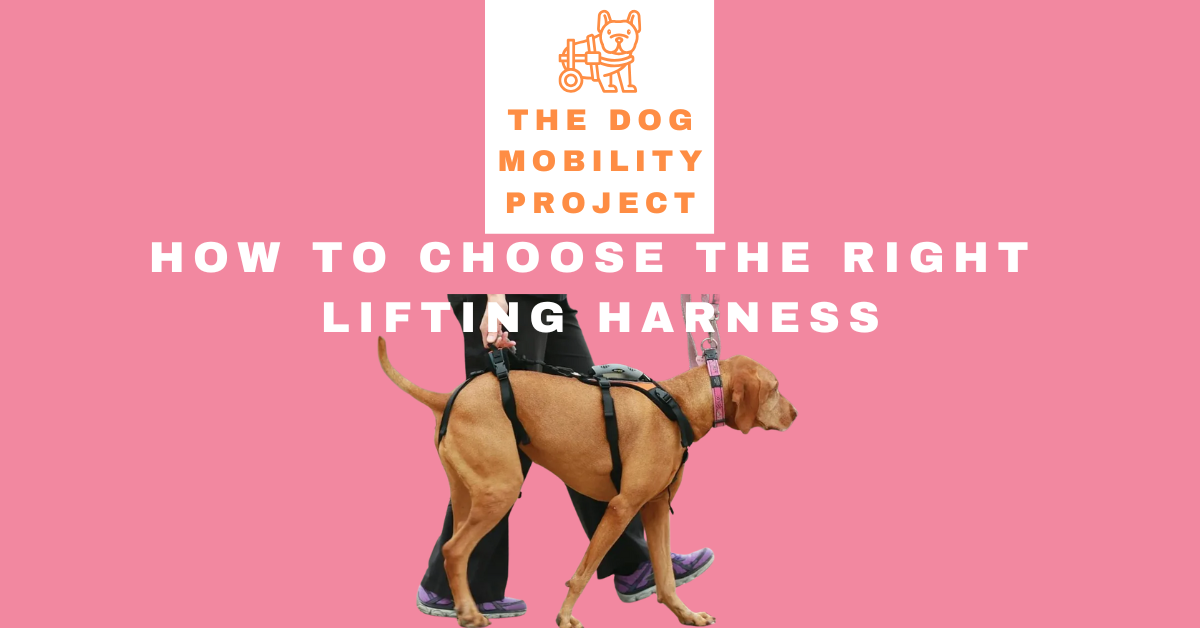
When your dog starts struggling to stand, walk, climb stairs, or stay balanced, a lifting harness can give them the extra support they need. But choosing a dog lifting harness isn’t as simple as finding one that fits.
Some dogs need support only under their back legs. Others need help at the front of their body or support from both ends. The right harness depends on where your dog is weak, how much assistance they need, and how you’ll use the harness in everyday life.
This guide will help you understand the different types of dog lifting harnesses, what features matter, how a harness should fit, and how to decide which type of support may be right for your dog.
What Is a Dog Lifting Harness?
A dog lifting harness is designed to help you support, stabilize, or partially lift a dog who has difficulty moving independently.
Unlike a standard walking harness, a mobility harness is designed to provide support underneath part of the dog’s body.
A lifting harness may be helpful for a dog who:
- Has weak back legs
- Struggles to stand up
- Needs help maintaining balance
- Has arthritis or another painful mobility condition
- Is recovering from certain injuries or surgeries
- Has a neurological condition affecting coordination or strength
- Needs assistance during bathroom breaks
- Can still walk but needs additional support
The American Animal Hospital Association (AAHA) includes appropriately fitted and padded harnesses among home modifications and accessories that may help mobility-compromised pets.
Before choosing one, though, ask yourself one important question: Where does my dog actually need support?
What Type of Lifting Harness Does My Dog Need?
There are three primary types of support: rear, front, and full-body.
| If your dog… | Consider |
|---|---|
| Has weak back legs but a strong front end | Rear-support harness |
| Has a front-leg or shoulder limitation | Front-support harness |
| Needs help at both ends | Full-body support harness |
| Needs occasional, temporary rear assistance | Support sling may be sufficient |
| Needs substantial support every day | More structured lifting harness |
| Needs sustained support to walk longer distances | Discuss whether a wheelchair or another mobility aid may be appropriate |
These aren’t absolute rules. Your dog’s diagnosis, pain level, weight-bearing ability, body shape, and veterinary recommendations should all factor into your decision.

If you’re not sure why your dog’s back legs are losing strength, start with our guide to weak back legs in dogs.
Rear-Support Harness: Who Is It For?
A rear-support harness supports the hindquarters while allowing the dog to use their front legs normally.
This type of harness may be appropriate when a dog’s primary mobility problem is in the back legs.
For example, a dog may:
- Have difficulty getting their hindquarters off the floor
- Walk normally with the front legs but have hind-leg weakness
- Lose balance at the rear
- Need help squatting during bathroom breaks
- Have difficulty maintaining their footing
- Need controlled assistance during recovery
Rear-support harnesses range from simple slings to more structured harnesses that wrap around the pelvis and hindquarters.
The amount of support matters.
A dog who only needs help with balance has very different needs from a dog whose caregiver must support a substantial portion of their body weight.
Front-Support Harness: Who Is It For?
Front-support harnesses are less commonly needed for general mobility loss but can be useful when a dog’s primary limitation involves the front limbs, shoulders, or front portion of the body.
A front-support harness may be considered when a dog:
- Has front-leg weakness
- Is recovering from certain front-limb injuries or procedures
- Needs help stabilizing the front of the body
- Has uneven strength between the front and rear
Don’t choose a front-support harness simply because your dog has trouble standing up.
A dog who can’t rise because their hind legs are weak may need rear or full-body support instead. Identifying where your dog is losing strength is more important than the activity you’re trying to help them perform.
Full-Body Support Harness: Who Is It For?
A full-body lifting harness provides support at both the front and rear of the dog.
This may be useful for dogs with more extensive mobility limitations or for larger dogs who are difficult to assist safely with a simple sling.
Full-body support may be worth considering when your dog:
- Needs help both standing and walking
- Is unstable throughout their body
- Has weakness affecting multiple limbs
- Requires frequent assistance throughout the day
- Needs more controlled support than a rear sling provides
- Is too large for you to safely support from one lifting point
Full-body harnesses can also give the caregiver more control over how much assistance is provided at each end of the dog.
Dog Sling vs. Lifting Harness: What’s the Difference?
A sling and a structured lifting harness can both provide support, but they’re not necessarily interchangeable.
A simple sling typically passes underneath part of the dog’s body and provides a lifting point above them. Some pet parents use a purpose-made sling, while a folded towel may provide temporary assistance in certain situations.
A lifting harness usually provides a more secure fit around the dog’s body and may include straps, padding, buckles, and dedicated lifting handles.
A sling may work well for:
- Occasional assistance
- Short bathroom trips
- Temporary mobility issues
- Dogs who need only light support
A more structured harness may make more sense for:
- Daily use
- Larger dogs
- Dogs requiring substantial assistance
- Dogs who need greater stability
- Progressive mobility problems
Comfort and control become increasingly important as the amount and frequency of assistance increase.
How Much Support Does My Dog Need?
This question is just as important as deciding where your dog needs support.
Think about your dog’s current mobility in three general levels.
Light Assistance
Your dog walks independently but occasionally loses balance or struggles with specific movements, such as standing after a long nap.
A simple rear-support harness or sling may be enough.
Partial Weight Support
Your dog can move their legs and bear some weight but needs you to provide consistent assistance.
A structured rear or full-body harness may provide better control.
Substantial Assistance
Your dog requires you to support a large portion of their body weight whenever they walk.
At this point, it’s worth discussing whether a harness remains the most practical mobility aid.
A wheelchair or another form of mobility support may allow some dogs greater independence while reducing the physical demand on the caregiver.
We have a separate guide specifically comparing a dog wheelchair vs. harness.
How Should a Dog Lifting Harness Fit?
A lifting harness should be secure enough to provide controlled support without creating unnecessary pressure, rubbing, or restriction.
Once the harness is fitted, check:
- Can you provide support without the harness sliding out of position?
- Are any straps rubbing behind the legs?
- Is there pressure on sensitive areas?
- Does the harness interfere with normal leg movement?
- Can your dog urinate and defecate normally?
- Are buckles or straps pressing against the skin?
- Does the harness shift when you lift?
- Can you comfortably reach the handles?
Recheck the fit regularly.
A dog’s body can change because of weight loss, muscle loss, recovery, or progression of a mobility condition. A harness that fit correctly several months ago may need adjustment later.
How Do I Measure My Dog for a Lifting Harness?
Every harness fits differently and the sizing can vary a great deal. There isn’t one universal measurement system for all lifting harnesses. Follow the manufacturer’s sizing instructions for the specific harness you’re considering.
Depending on the design, a manufacturer may ask for measurements such as:
- Weight
- Chest girth
- Abdominal girth
- Hip or rear girth
- Body length
- Height
Don’t assume that your dog’s normal collar or walking-harness size will translate to a lifting harness.
If your dog falls between sizes, check the manufacturer’s recommendations rather than automatically sizing up or down.
Measure your actual dog whenever possible instead of relying on breed or weight alone. Two dogs of the same weight can have very different body shapes.
Can My Dog Pee and Poop While Wearing a Lifting Harness?
This is one of the most important practical questions to ask before buying a harness.
Many mobility-impaired dogs need the most assistance during bathroom breaks. A harness that’s difficult to use for toileting can quickly become frustrating.
Look at how the rear portion of the harness sits around the dog’s:
- Abdomen
- Groin
- Genitals
- Hind legs
This is particularly important for male dogs, because some rear-support designs may sit differently around the penis and prepuce.
The harness should allow your dog to assume an appropriate bathroom position without unnecessary obstruction.
If toileting assistance will be one of your main uses, make that a primary selection criterion rather than an afterthought.
Can My Dog Wear a Lifting Harness All Day?
Don’t assume that every lifting harness is designed for continuous wear.
Recommendations vary by harness design and by the individual dog.
A harness that’s comfortable during a five-minute bathroom break may cause rubbing or pressure when worn for hours.
If your dog wears a harness for extended periods, regularly check the skin for:
- Redness
- Chafing
- Moisture
- Hair loss
- Pressure marks
- Skin irritation
Pay particular attention around straps, leg openings, the groin, and other pressure points.
Follow the manufacturer’s wear instructions and ask your veterinarian or rehabilitation professional about extended use if your dog requires frequent assistance.
What Features Matter Most in a Dog Lifting Harness?
Don’t get distracted by a long list of product features. Start with function, what it does, how it supports your dog, and how it fits your dog’s needs.
Support in the Right Place
The harness needs to support the part of your dog’s body that’s actually weak.
Secure Fit
A harness that constantly slides, twists, or shifts may be difficult to use safely.
Padding
Padding can help reduce rubbing and concentrated pressure, particularly when the harness is used frequently. AAHA specifically references fitted and padded harnesses when discussing mobility support for pets.
Adjustable Straps
Adjustability helps accommodate individual body shapes and changes in your dog’s body over time.
Accessible Handles
You should be able to reach and hold the lifting handles without repeatedly bending into an uncomfortable position.
Toileting Clearance
If your dog needs help outside, make sure the harness doesn’t make bathroom breaks more difficult.
Washable Materials
Mobility equipment gets dirty. Bathroom accidents, mud, wet grass, and everyday use make easy cleaning a practical advantage.
Caregiver Comfort
Don’t forget about yourself.
If you’re repeatedly assisting a 70-pound dog, handle placement and lifting position matter. A harness that helps your dog but forces you into an awkward lifting position isn’t an ideal solution.
What About a Harness for a Dog Recovering From Surgery?
Don’t choose a post-surgical lifting harness based solely on the type of surgery.
Ask your veterinarian where your dog can safely be supported and how much weight they’re allowed to bear.
The location of an incision, surgical restrictions, pain, and rehabilitation plan may affect what type of harness is appropriate.
This is also an area where veterinary rehabilitation can be helpful. AAHA explains that rehabilitation programs can be tailored to specific areas of weakness, stiffness, imbalance, injury, and post-surgical recovery.
Learn more about veterinary physical rehabilitation from AAHA
Do I Need a Lifting Harness or a Dog Wheelchair?
A lifting harness works best when human assistance is part of the mobility solution.
A wheelchair provides a different type of support and may allow a dog to move with greater independence.
A harness may make sense when your dog:
- Can still walk
- Needs help getting upright
- Needs occasional balance assistance
- Requires support for short activities
- Can bear some of their own weight
A wheelchair may be worth discussing when:
- Your dog needs sustained support while walking
- Their hindquarters repeatedly collapse
- Paw dragging is becoming significant
- Walking requires you to continuously support much of their weight
- Your dog still wants to move but can’t maintain mobility without substantial assistance
And it doesn’t always have to be one or the other.
Some dogs use a harness for transfers or bathroom breaks and a wheelchair for longer periods of activity.
For a detailed comparison, read Dog Wheelchair vs. Harness: Which Mobility Aid Is Right for Your Dog?.
Already Have a Harness? Here’s How to Use It
Choosing the harness is only half of the equation.
How much should you lift? Should your dog still use their legs? What if they can stand on carpet but not hardwood? What about stairs, potty breaks, or getting into the car?
We cover those questions separately in our practical guide:
How to Help a Dog Stand Up and Walk With a Support Harness
Keeping these two decisions separate makes mobility care easier:
This guide helps you choose the right type of harness. The companion guide helps you use that support in everyday life.
What If My Dog’s Mobility Changes?
The harness that works today may not be the equipment your dog needs six months from now.
Mobility can improve during recovery, fluctuate with chronic conditions, or decline with progressive disease.
Watch for changes such as:
- Needing more help to stand
- Increasing falls
- More frequent paw dragging
- Shorter walking tolerance
- Greater dependence on you to support body weight
- Difficulty using equipment that previously worked well
A change doesn’t automatically mean your dog needs a wheelchair or another device. It means it’s time to reassess what your dog can currently do and whether their existing support still meets their needs.
If you’re noticing several different changes and aren’t sure what they mean, start with the Dog Mobility Symptom Finder.
Frequently Asked Questions
What is the best lifting harness for a dog with weak back legs?
There isn’t one best harness for every dog. If the weakness is primarily in the hind legs and the front legs remain strong, a rear-support harness may provide enough assistance. Dogs with more extensive weakness may need full-body support.
The underlying cause and severity of the weakness should also be considered.
Is a rear-support harness better than a full-body harness?
Neither is universally better.
A rear-support harness targets hind-leg weakness while a full-body harness provides assistance at both ends. Choose based on where your dog needs support and how much assistance you need to provide.
Can I use a regular walking harness to lift my dog?
A standard walking harness isn’t necessarily designed to support a dog’s body weight.
If your dog needs lifting assistance, use equipment specifically designed for that purpose and follow its weight, fit, and usage instructions.
Can I use a towel instead of a dog lifting harness?
A folded towel may provide temporary support for some dogs, particularly under the abdomen or hindquarters.
For frequent or substantial assistance, a purpose-made lifting harness generally provides more secure and controllable support.
What kind of harness does a dog with arthritis need?
It depends on where arthritis affects the dog and what movement has become difficult.
Some dogs need only occasional rear support when rising. Others have limitations affecting multiple areas of the body.
Rather than choosing a harness based on the word arthritis, choose based on your dog’s actual mobility and where they need assistance.
How do I know if my dog’s lifting harness is too tight?
Watch for redness, pressure marks, chafing, restricted movement, difficulty toileting, or straps digging into the body.
The harness needs to remain secure when supporting your dog without creating unnecessary pressure.
When should I stop using a lifting harness?
Reassess the harness if your dog’s mobility improves, their body shape changes, the harness begins causing discomfort, or they require substantially more support than the harness can practically provide.
A change in mobility is also a good reason to speak with your veterinarian about whether your dog’s condition or mobility plan needs to be reevaluated.
Choose the Harness Based on Your Dog, Not the Diagnosis
Two dogs with the same diagnosis may need completely different types of mobility support.
One dog with arthritis may need a little rear support getting off the floor. Another may walk independently once they’re standing. A dog with a neurological condition may need help primarily with balance, while another may need substantial weight support.
That’s why the best dog lifting harness isn’t simply the one recommended for your dog’s condition.
It’s the one that appropriately supports the way your dog moves today.
Start with where your dog is weak. Determine how much assistance they need. Consider fit, comfort, toileting, and how often you’ll use the harness.
Then keep reassessing.
The goal isn’t simply to lift your dog. It’s to give them the right amount of support to move as safely and comfortably as possible.
Related Articles
This article provides educational information and isn’t a substitute for veterinary diagnosis or treatment.





Leave a Reply