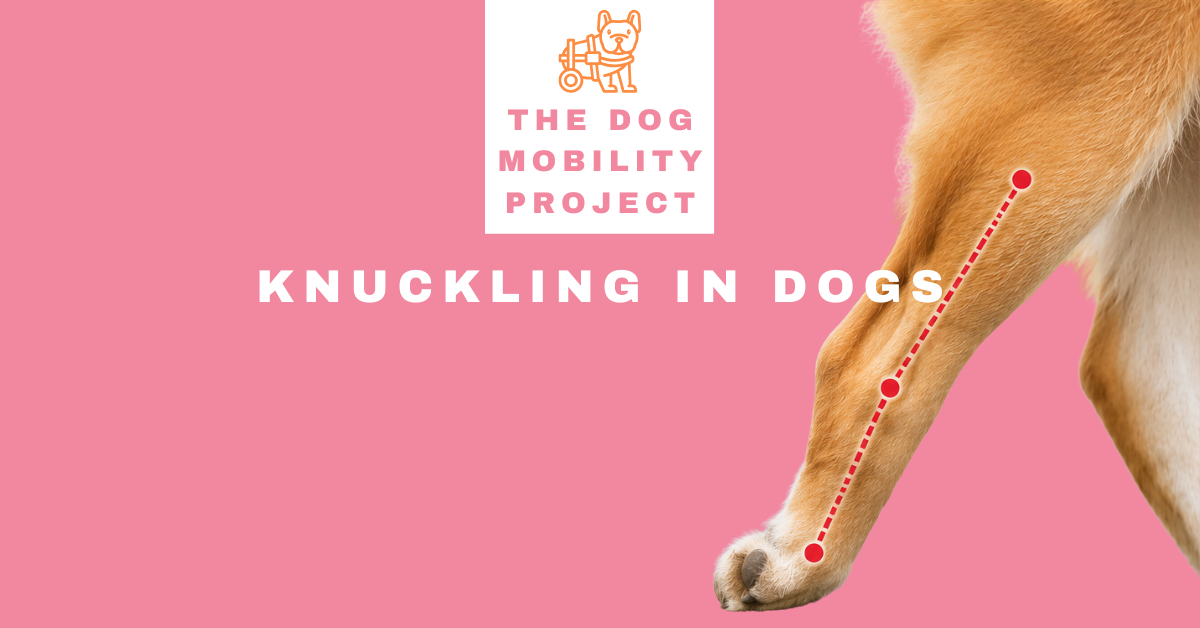
If you’ve noticed your dog’s paw folding under while walking, dragging across the ground, or walking on the top of their foot instead of their paw pads, you’re likely witnessing a condition known as knuckling.
Knuckling is not a disease itself. Instead, it’s a symptom that something is affecting your dog’s nervous system, muscles, joints, or ability to control their limbs, and they may be experiencing changes in mobility. While it can be alarming to see, early recognition and veterinary care can significantly improve your dog’s quality of life.
In this guide, we’ll explain what dog knuckling is, what causes it, how veterinarians diagnose it, and what treatment options may help—including when mobility aids can keep your dog active and comfortable.
What Is Knuckling in Dogs?
Knuckling occurs when a dog is unable to correctly place its paw on the ground. Instead of walking on the paw pads, the foot rolls under, causing the dog to bear weight on the top of the paw.
Many owners first notice these early signs of mobility loss:
- Dragging toes
- Scuffed or worn toenails
- Walking on the tops of the paws
- Frequent stumbling
- Difficulty standing
- Crossing the back legs while walking
- Loss of coordination
- Weakness in one or more limbs
Knuckling most commonly affects the rear legs but can also occur in the front legs depending on the underlying condition.

The image above is an exaggerated version of what knuckling looks like in a dog. Not every dog will walk fully on the top of its paw. Some dogs may scrape their toenails while walking, while others only drag their back feet when they’re tired. If you see unevenly worn toenails or scrapes on the top of your dog’s paw, it’s time to speak with your veterinarian.
s My Dog Knuckling an Emergency?
One of the first questions most pet parents ask isn’t “What is knuckling?”—it’s “How worried should I be?”
The answer depends on how quickly the knuckling developed and what other symptoms are present.
Seek emergency veterinary care if your dog:
- Suddenly begins knuckling after a fall, jump, or injury
- Cannot stand or walk normally
- Drags one or more legs
- Appears to be in severe pain
- Cries out when moving
- Loses bladder or bowel control
- Becomes progressively weaker over a matter of hours
These symptoms can indicate a serious spinal cord injury or neurological emergency where prompt treatment may improve the chances of recovery.
Schedule a veterinary appointment soon if your dog:
- Occasionally knuckles but otherwise seems comfortable
- Has gradually become weaker over weeks or months
- Has begun scuffing the tops of the paws
- Frequently slips on smooth floors
- Takes longer to stand after resting
- Appears clumsier than usual
While these signs may not require an emergency visit, they should never be ignored. Dogs often compensate remarkably well for pain or weakness, meaning subtle symptoms may represent the early stages of a larger mobility problem.
Why Does Knuckling Happen?
Normal walking depends on constant communication between the brain, spinal cord, nerves, muscles, and joints.
When any part of that communication system is disrupted, your dog may lose awareness of where their foot is, a neurological function called proprioception.
Without proper proprioception, dogs cannot consistently correct the position of their paws, resulting in knuckling.

What Should You Do Today If You Notice Knuckling?
Until your veterinarian determines the cause, your goal should be to protect your dog from further injury rather than encouraging more exercise.
Start by:
- Keeping walks short and controlled
- Preventing jumping on or off furniture
- Limiting stair use whenever possible
- Walking on a leash instead of allowing free running
- Checking the top of the affected paw for scrapes or worn nails
- Recording a short video of your dog’s gait before your appointment
Avoid testing your dog’s strength by encouraging them to keep walking if they appear tired or unstable. Likewise, resist the urge to perform internet-recommended exercises until you know why the knuckling is happening.
The earlier your veterinarian can identify the underlying cause, the sooner an appropriate treatment plan can begin.
What Knuckling Can Look Like in Everyday Life
Many owners don’t notice knuckling immediately because it rarely begins dramatically.
Instead, they notice small changes during everyday routines.
Your dog may:
- Catch one paw while walking across the yard
- Occasionally stumble when turning around
- Wear one toenail noticeably shorter than the others
- Leave faint scrape marks on the driveway
- Trip going up the stairs
- Seem clumsy only after a longer walk
- Walk normally on grass but struggle on hardwood floors
These small changes are often the first indication that your dog is having difficulty sensing where the paw is positioned.
Common Causes of Knuckling in Dogs
While knuckling itself isn’t a diagnosis, neurological disease is among the most common causes seen by veterinary neurologists.
Some conditions develop slowly over months, while others appear suddenly over the course of a few hours.
Understanding how the knuckling began often provides your veterinarian with valuable clues about the underlying cause.
1. Degenerative Myelopathy (DM)
Degenerative Myelopathy is one of the most common causes of gradual knuckling in older dogs.
Early signs include:
- Mild dragging of the toes
- Worn toenails
- Occasional knuckling
- Weakness in the hind legs
- Difficulty rising
As the disease progresses, coordination decreases and many dogs eventually require mobility assistance.
Learn more: Degenerative Myelopathy in Dogs
2. Intervertebral Disc Disease (IVDD)
IVDD occurs when a spinal disc compresses the spinal cord.
Symptoms often appear suddenly and may include:
- Knuckling
- Pain
- Reluctance to move
- Dragging the rear legs
- Paralysis in severe cases
Early veterinary treatment is critical with IVDD. The sooner your dog is properly diagnosed, the sooner treatment can begin, which often yields a better recovery.
3. Peripheral Nerve Injuries
Damage to the nerves controlling a limb can prevent a dog from recognizing paw position.
Common causes include:
- Trauma
- Surgery
- Bite wounds
- Stretch injuries
Recovery depends on the severity of nerve damage. For example, a dog with DM will never fully regain its proprioception. But a dog who suffered a traumatic injury may be able to regain proper paw placement through rehab therapy.
4. Fibrocartilaginous Embolism (FCE)
Often called a “spinal stroke,” FCE typically occurs suddenly during exercise. Dogs suffering from FCE may lose coordination within minutes or hours.
Luckily, many dogs improve with intensive rehabilitation and structured exercise. It’s incredibly important that a dog diagnosed with a Fibrocartilaginous Embolism work with a rehab specialist during their recovery.
5. Brain Disorders
Conditions affecting the brain, including tumors, inflammation, or strokes, can interfere with motor control and result in knuckling.
These cases often include additional neurological symptoms such as head tilt, seizures, or changes in behavior.
6. Wobbler Syndrome
Common in large breeds such as Great Danes and Dobermans, Wobbler Syndrome compresses the spinal cord in the neck.
Dogs often develop:
- Front leg weakness
- Rear leg weakness
- Knuckling
- An unsteady gait
7. Arthritis
Although arthritis itself doesn’t directly cause neurological knuckling, severe joint pain can alter a dog’s gait enough that paw placement becomes inconsistent.
Dogs with arthritis may also compensate for painful joints, leading to stumbling and occasional paw flipping.
Breeds More Commonly Affected
While any dog can develop knuckling, some breeds are more susceptible because of inherited orthopedic or neurological conditions.
Examples include:
- German Shepherds
- Dachshunds
- Corgis
- Labrador Retrievers
- Golden Retrievers
- Boxers
- Great Danes
- Doberman Pinschers
- French Bulldogs
How Veterinarians Diagnose Knuckling
Your veterinarian will begin with a neurological examination.
One of the most common tests is the paw placement test. During this test, the veterinarian gently flips your dog’s paw so the top touches the floor. A healthy dog immediately corrects the paw position. A delayed or absent correction suggests a neurological problem.
Additional diagnostics may include:
- X-rays
- MRI
- CT scan
- Blood work
- Neurological consultation
- Genetic testing (for Degenerative Myelopathy)
Could It Be Something Other Than Knuckling?
Not every unusual gait is true knuckling.
Many mobility problems can appear similar at first glance.
| If you notice… | It may indicate… |
|---|---|
| Paw folds completely underneath | Knuckling or proprioceptive deficit |
| Paw drags behind the dog | Paw dragging from weakness or nerve disease |
| Dog hops with both back legs | Hip or spinal conditions |
| Dog slips repeatedly | Weakness, arthritis, poor traction, or neurological disease |
| Dog limps but paw placement is normal | Orthopedic injury rather than knuckling |
Why Early Diagnosis Matters
One of the biggest misconceptions about knuckling is that owners should wait until it becomes more obvious.
In reality, knuckling is often one of the earliest neurological signs that something isn’t functioning normally.
Depending on the underlying condition, early treatment may:
- Slow progression
- Reduce inflammation
- Prevent additional injury
- Preserve muscle strength
- Improve coordination
- Increase the number of treatment options available
Even if the condition cannot be cured, identifying it early often allows dogs to remain comfortable and mobile for much longer.
What Happens During a Veterinary Examination for Knuckling?
Don’t worry if your veterinarian doesn’t have a diagnosis after the first few minutes. Knuckling can have many different causes, and the examination is designed to narrow the possibilities before deciding whether additional testing is necessary. If your dog has started knuckling, don’t be surprised if your veterinarian spends as much time watching your dog walk as they do examining the affected paw.
That’s because knuckling is almost never a problem with the paw itself. Instead, it is usually a sign that something is interfering with the nerves, spinal cord, muscles, or brain’s ability to control that limb.
The goal of the examination is to answer one important question:
Why is the paw turning under?
Finding that answer helps determine whether the problem is orthopedic, neurological, muscular, or a combination of several conditions.
Step 1: Watching Your Dog Walk
One of the first things your veterinarian will do is observe your dog’s gait.
They’ll likely ask your dog to:
- Walk toward them
- Walk away from them
- Turn in both directions
- Walk at different speeds
- Stand still
- Rise from a sitting or lying position
While you’re watching your dog’s paw, your veterinarian is watching the entire body.
They may look for:
- Which paw is knuckling
- Whether one or multiple limbs are affected
- Changes in stride length
- Weakness in the front or back legs
- Muscle loss
- Balance problems
- Paw dragging
- Crossing of the hind legs
- Uneven weight bearing
- Difficulty turning
These subtle observations often provide important clues about where the problem may be originating.
Step 2: Testing Paw Placement (Proprioception)
One of the most recognizable parts of the neurological examination is the paw placement test, sometimes called a proprioception test.
Your veterinarian will gently turn your dog’s paw so the top of the foot rests on the floor.
A healthy dog almost immediately flips the paw back into the correct position.
If that correction is delayed—or doesn’t happen at all—it suggests that the communication between the paw, spinal cord, and brain may not be working normally.
This doesn’t diagnose a specific disease on its own, but it confirms that further investigation is needed.
Step 3: Checking Reflexes
Next, your veterinarian may evaluate several spinal reflexes.
These quick tests help determine whether the nerves controlling the legs are functioning normally.
They may check:
- Knee reflexes
- Withdrawal reflexes
- Muscle tone
- Limb strength
- Pain sensation
- Tail movement
These findings help narrow down which part of the nervous system may be affected and whether the problem is more likely to involve the spinal cord, peripheral nerves, muscles, or joints.
Step 4: Feeling the Spine and Joints
Not every dog that knuckles has a neurological disease.
Pain from the spine or joints can sometimes alter the way a dog moves, making the gait appear abnormal.
Your veterinarian will likely feel:
- The neck
- The back
- The hips
- The knees
- The shoulders
- Individual joints
They’re checking for:
- Pain
- Swelling
- Reduced range of motion
- Muscle loss
- Joint instability
- Areas of tenderness
A dog with arthritis may move differently than a dog with IVDD, even if both occasionally scuff their paws.
Step 5: Deciding Whether Imaging Is Needed
Depending on the examination findings, your veterinarian may recommend additional testing.
This could include:
- X-rays to evaluate the bones and joints
- Bloodwork to rule out metabolic conditions
- MRI or CT scans to examine the spinal cord and surrounding structures
- Referral to a veterinary neurologist
- Referral to a rehabilitation specialist
Advanced imaging is especially important when spinal cord disease, nerve compression, or another neurological disorder is suspected.
What Your Veterinarian Is Trying to Rule Out
Knuckling is a symptom—not a diagnosis.
Your veterinarian may be considering several possible causes, including:
| Possible condition | Why it may cause knuckling |
|---|---|
| Intervertebral Disc Disease (IVDD) | Pressure on the spinal cord can interfere with normal paw placement. |
| Degenerative Myelopathy | Progressive spinal cord degeneration often causes delayed paw correction and weakness. |
| Peripheral nerve injury | Damaged nerves may prevent the brain from accurately controlling the limb. |
| Fibrocartilaginous Embolism (FCE) | A spinal cord injury caused by disrupted blood flow can produce sudden knuckling. |
| Brain disease | Less commonly, diseases affecting the brain can alter limb awareness and coordination. |
| Severe orthopedic disease | Pain or instability may change the way a dog carries the limb, although true knuckling is usually neurological. |
This is why two dogs with the same symptom can have very different treatment plans.
Don’t Worry if You Don’t Remember Everything
A neurological examination can feel overwhelming.
You may hear unfamiliar words like:
- Proprioception
- Neurological deficits
- Deep pain sensation
- Reflexes
- Spinal cord compression
- Cervical
- Thoracolumbar
You don’t need to memorize every medical term during the appointment.
Instead, focus on asking questions such as:
- What do you think is causing the knuckling?
- Do you believe this is orthopedic or neurological?
- Is this something that requires immediate treatment?
- What additional testing do you recommend?
- Should I limit my dog’s activity until we know more?
- What signs would make this an emergency?
Understanding the reason behind your dog’s knuckling is far more important than remembering the terminology.
Once you know the underlying diagnosis, you’ll be in a much better position to make informed decisions about treatment, rehabilitation, and long-term mobility support.
Don’t Wait Until…
Many pet parents look back and realize there were warning signs long before the diagnosis.
Try not to wait until your dog:
- Can no longer stand without assistance
- Begins falling frequently
- Develops bleeding toenails from dragging
- Loses muscle mass in the hind legs
- Stops wanting to go on walks
- Becomes unable to climb even a single step
Small mobility changes are much easier to address than advanced neurological deficits.
If something about your dog’s movement feels different—even if you can’t quite explain why—it’s worth discussing with your veterinarian.
Your Next Step Depends on the Cause
Knuckling is a symptom—not a diagnosis.
Once your veterinarian determines the underlying cause, your treatment plan will become much clearer.
If your dog is diagnosed with:
- Intervertebral Disc Disease (IVDD) → Learn about treatment options and recovery expectations.
- Degenerative Myelopathy (DM) → Understand disease progression and long-term mobility planning.
- Arthritis → Explore pain management, weight control, and joint support.
- Peripheral nerve injury → Learn what recovery may look like and when rehabilitation can help.
- Progressive mobility loss → Discover how harnesses, rehabilitation, and wheelchairs can help maintain independence.
Remember, two dogs can both be knuckling for completely different reasons. The goal isn’t simply to stop the paw from folding under—it’s to identify why it’s happening.
Why Dogs Hide Mobility Problems So Well
One of the most frustrating things about mobility loss is that dogs rarely stop moving altogether.
Instead, they quietly adapt.
They shift more weight onto stronger legs.
They avoid jumping without making a fuss.
They shorten their stride.
They slow down just enough that it feels like normal aging.
Because these changes happen gradually, many pet parents don’t realize anything is wrong until the mobility problem has progressed.
By the time a dog begins falling regularly or can no longer stand, they may have been compensating for weeks or even months.
That’s why small changes—like worn toenails, occasional knuckling, or hesitation before stairs—deserve attention.
You aren’t looking for dramatic symptoms.
You’re looking for patterns.
What I Wish Every Pet Parent Knew About Knuckling
When owners first notice knuckling, many hope it’s just an awkward step.
Sometimes it is.
But when that awkward step becomes a pattern, your dog is trying to tell you something.
Dogs rarely complain about pain the way people do. Instead, they adapt. They shift their weight, shorten their stride, rely more heavily on stronger limbs, and quietly change how they move.
Knuckling is one of those changes that is easy to overlook because a dog may continue walking surprisingly well despite an underlying neurological problem.
The good news is that noticing the change is the first step toward helping your dog. Whether the solution involves medication, rehabilitation, surgery, a harness, or eventually a wheelchair, early recognition gives you more options—and gives your dog the best opportunity to stay active, comfortable, and engaged in daily life.
Knuckling Treatment Options
Treatment depends entirely on the underlying cause. There is no “one-size-fits-all” cure for dog knuckling. Every case will be unique and hinges entirely on your dog’s diagnosis.
Your veterinarian may recommend:
- Anti-inflammatory medications
- Pain management
- Physical rehabilitation
- Hydrotherapy
- Laser therapy
- Weight management
- Surgery
- Neurological care
- Dog wheelchair use
Early intervention often leads to better long-term mobility.
Can Physical Therapy Help?
For many dogs, physical therapy can absolutely help and will be recommended for most dogs that are dragging their feet.
Rehabilitation may include:
- Balance exercises
- Cavaletti rails
- Underwater treadmill sessions
- Strength-building exercises
- Passive range-of-motion therapy
- Massage
- Proprioceptive training
Physical therapy can improve strength, coordination, and confidence while slowing muscle loss.
When Does a Dog Need a Wheelchair?
A wheelchair is not a sign that you’ve given up on recovery. Instead, it can help dogs:
- Stay active
- Maintain muscle mass
- Continue daily walks
- Participate in rehabilitation
- Improve mental well-being
- Preserve independence
Many dogs use wheelchairs temporarily while recovering from surgery or injury, while others rely on them long-term for progressive neurological conditions.
The goal is always to improve quality of life, not replace treatment.
Helping Prevent Paw Injuries
Dogs that knuckle frequently often scrape the tops of their paws.
To help prevent injuries:
- Inspect the paws after every walk.
- Keep nails trimmed.
- Use protective dog boots when appropriate.
- Avoid rough surfaces during flare-ups.
- Monitor for cuts, sores, or bleeding.
Repeated abrasions can become painful and increase the risk of infection.
Frequently Asked Questions About Dog Knuckling
What is dog knuckling?
Dog knuckling occurs when a dog walks or stands with the top of one or more paws touching the ground instead of the paw pads. It is typically a sign of an underlying neurological or orthopedic condition rather than a disease itself. Knuckling should always be evaluated by a veterinarian, as it can indicate nerve damage, spinal cord disease, or other serious medical issues.
What is the difference between knuckling and dragging feet?
Although they often occur together, knuckling and dragging feet are not the same thing.
Knuckling happens when a dog’s paw folds under, causing them to bear weight on the top of the foot. This usually indicates a loss of proprioception (the body’s ability to sense limb position) and is commonly associated with neurological disorders.
Dragging feet, on the other hand, occurs when a dog fails to lift the paw high enough while walking, causing the toes or nails to scrape along the ground. Dragging may result from weakness, pain, arthritis, muscle loss, or neurological disease.
Some dogs experience only dragging, while others both drag their feet and knuckle over. Because both symptoms can indicate serious underlying conditions, they should be evaluated by a veterinarian as soon as possible.
Is dog knuckling an emergency?
It can be. If knuckling develops suddenly—especially if it is accompanied by severe pain, paralysis, inability to stand, loss of bladder or bowel control, or difficulty walking—it should be treated as a veterinary emergency. Sudden knuckling may indicate conditions such as Intervertebral Disc Disease (IVDD), spinal trauma, or a fibrocartilaginous embolism (FCE), all of which require prompt medical attention.
Can arthritis cause knuckling?
While arthritis can contribute to weakness and changes in gait, it is not usually the direct cause of knuckling. Dogs with advanced arthritis may occasionally stumble or have difficulty lifting their feet, but true knuckling is more commonly associated with neurological conditions affecting the brain, spinal cord, or peripheral nerves. A veterinary examination is needed to determine the underlying cause.
Can dog knuckling be treated?
Treatment depends entirely on the underlying condition causing the knuckling. Depending on the diagnosis, treatment may include medication, surgery, physical rehabilitation, weight management, mobility aids such as dog wheelchairs or support harnesses, and at-home exercises. Early diagnosis often leads to better outcomes and may help slow disease progression.
Can a dog recover from knuckling?
Some dogs recover completely, while others require long-term management. Recovery depends on factors such as the underlying diagnosis, the severity of nerve damage, and how quickly treatment begins. Dogs recovering from injuries or certain spinal conditions may regain normal function, while progressive neurological diseases such as Degenerative Myelopathy focus on maintaining mobility and quality of life rather than curing the disease.
Which dog breeds are more likely to experience knuckling?
Knuckling can occur in any breed but is more commonly seen in dogs predisposed to neurological or orthopedic disorders. Breeds at higher risk include:
- German Shepherds
- Pembroke Welsh Corgis
- Dachshunds
- Boxers
- Labrador Retrievers
- Golden Retrievers
- Great Danes
- French Bulldogs
Breed alone does not determine the cause, so every dog with knuckling should be examined by a veterinarian.
Can physical therapy help dogs that knuckle?
Yes. Veterinary rehabilitation and physical therapy can improve strength, balance, coordination, and proprioception in many dogs with knuckling. Depending on the diagnosis, treatment may include therapeutic exercises, underwater treadmill therapy, balance equipment, stretching, massage, laser therapy, and home exercise programs. Physical therapy is often most effective when combined with treatment for the underlying condition.
Should I walk my dog if they are knuckling?
It depends on the cause and severity. Mild, chronic neurological conditions may benefit from controlled exercise under veterinary guidance, while dogs with sudden knuckling, severe pain, or suspected spinal injuries should have their activity restricted until they have been evaluated. Your veterinarian can recommend an appropriate exercise plan based on your dog’s diagnosis.
When should I take my dog to the veterinarian for knuckling?
You should schedule a veterinary appointment as soon as you notice persistent knuckling, even if your dog seems otherwise comfortable. Seek emergency veterinary care immediately if knuckling develops suddenly or is accompanied by:
- Inability to stand or walk
- Sudden paralysis
- Severe pain
- Loss of bladder or bowel control
- Rapidly worsening weakness
Early diagnosis gives your veterinarian the best opportunity to identify the cause and begin treatment before permanent damage occurs.
Can knuckling go away on its own?
Sometimes, particularly if it’s caused by a temporary injury or mild inflammation. However, persistent or worsening knuckling should always be evaluated by a veterinarian.
Is knuckling painful?
The act of knuckling is not usually painful, but the condition causing it may be. Dogs with spinal disease, arthritis, or nerve injuries can experience significant discomfort.
Can older dogs develop knuckling?
Yes. Age-related neurological disorders, arthritis, and muscle weakness make senior dogs more susceptible.
Is knuckling always neurological?
Not always. Orthopedic disease, trauma, severe arthritis, and muscle injuries can also contribute, but neurological conditions are among the most common causes.
Final Thoughts
Seeing your dog knuckle can be frightening, but it doesn’t automatically mean the worst. In many cases, early diagnosis, rehabilitation, and supportive care can help dogs remain active and enjoy an excellent quality of life.
The most important step is recognizing that knuckling is a symptom—not a diagnosis. By working closely with your veterinarian and addressing the underlying cause, you can create a treatment plan tailored to your dog’s needs.
Whether that plan includes rehabilitation, medication, surgery, or mobility aids, many dogs continue to live happy, adventurous lives with the right support.
Remember: If you notice your dog’s paw consistently folding under or dragging while walking, schedule a veterinary examination as soon as possible. Early intervention often leads to the best outcomes for your dog’s long-term mobility and comfort.



Leave a Reply