
A buyer’s guide for pet parents who are overwhelmed by the options, focused only on reputable, name-brand wheelchairs (no cheap knockoffs). Although certainly affordable, the “off-brand” carts are complicated to set up, prone to breaking, and not always the most comfortable or supportive for your dog.
Which is why I chose to compare the major makers, explain what works best for specific breeds and body shapes, and link to real, public vet or clinic recommendations so you can double-check with experts.
Quick takeaways
- Custom-built brands (K9 Carts, Eddie’s Wheels, Ruff Rollin’) are best if your dog needs a precise fit (very small breeds, short-legged breeds like corgis/dachshunds, heavy/large breeds, or dogs with unusual anatomy).
- Modular/adjustable brands (Walkin’ Wheels / Walkin’ Pets) are great as a first chair for many pet parents because they’re faster to order and easier to adjust at home. Many teaching hospitals stock or loan them.
- Veterinary & rehab professionals commonly reference these same name brands when recommending carts; peer-reviewed work shows mobility carts improve quality of life for dogs and caretakers.
Brands we cover (name-brand only)
- K9 Carts — custom, vet-designed, long history (1961). Best for custom fits and active dogs.
- Walkin’ Wheels / Walkin’ Pets — adjustable kits and full-support quads, widely available and often stocked by clinics. Good starter and budget-conscious premium choice.
- Eddie’s Wheels — handcrafted, custom-built in the USA with a unique padded saddle and “variable axle” feature for balance adjustments. Favored by many rehab specialists.
- Ruff Rollin’ (custom cart builders) — boutique, custom carts with lifetime warranty claims (check current availability & reviews).
- Doggon’ Wheels / Best Friend Mobility / other reputable small builders — established makers used by some veterinary hospitals and rehab pros; worth comparing on fit & service.
How to choose by breed / body type (simple rules)
1) Small & teacup breeds (Chihuahuas, Yorkies, Toy Poodles)
- Top picks: K9 Carts (custom small carts), Ruff Rollin’ (small/teacup expertise), Walkin’ Wheels MINI. K9 and Ruff Rollin’ are made to precisely fit very small frames; Walkin’ Wheels offers an off-the-shelf mini option that’s easy to get quickly.
- Why: Small dogs often need narrower saddles and finer axle placement to avoid chafing and to allow them to lie down in the cart.
2) Short-leg, long-body breeds (Corgis, Dachshunds)
- Top picks: Eddie’s Wheels (variable axle & saddle), K9 Carts (custom contouring), Walkin’ Wheels (Dachshund-specific sizing exists). Short-leg breeds are prone to poor fit with standard frames — custom or brands that explicitly list short-legged models are safer.
3) Medium breeds (Beagles, Cocker Spaniels, Bulldogs)
- Top picks: Walkin’ Wheels (adjustable), K9 Carts (custom if unique proportions), Eddie’s Wheels (custom). For most common medium breeds, an adjustable Walkin’ Wheels often works; if the dog has unusual proportions, go custom.
4) Large & giant breeds (Labrador, German Shepherd, Great Dane)
- Top picks: K9 Carts (engineered for heavier dogs), Eddie’s Wheels (sturdy builds), some large Walkin’ Wheels sizes. For heavy or very active large dogs, choose manufacturers with heavy-duty frames and vet/orthopedic design. K9 Carts emphasizes vet design and higher-weight builds.
5) Dogs with front-limb weakness or quad weakness
- Top picks: K9 Carts (convertible full-support), Walkin’ Wheels Full Support/4-wheel models, Eddie’s Wheels Quads. Make sure the brand offers a true full-support/quad option and consult a rehab vet.
Brand-by-brand breakdown (what they’re best at + pros/cons)
K9 Carts
- What it is: Custom-built carts, founded by a veterinary orthopedic surgeon; long history and strong vet/rehab reputation.
- Best for: Dogs requiring custom contours (large breeds, short-legged breeds, complex cases).
- Pros: Biomechanically designed (vet), custom fit, durable, multiple wheel/terrain options.
- Cons: Lead time + cost are higher than off-the-shelf adjustable carts; you’ll need precise measurements.
- Price range: Typically premium — expect several hundred to >$1,000 depending on custom options.
- Vet/clinic note: K9 Carts is often recommended by rehab professionals and sold via veterinary suppliers.
Walkin’ Wheels / Walkin’ Pets
- What it is: Adjustable, modular wheelchair kits and full-support quads; widely available and often stocked by veterinary hospitals.
- Best for: First wheelchair for many dogs, families who want fast shipping and easy adjustability.
- Pros: Readily adjustable in the field, competitive price tiers, full-support models available, clinic loaner programs exist.
- Cons: Modular systems sometimes need tweaks to perfectly fit unusual body types; some owners later upgrade to custom carts for long-term use.
- Price range: Mid-range (hundreds USD for rear-support; higher for quad/full-support).
Eddie’s Wheels
- What it is: Handcrafted custom wheelchairs in the USA with a padded saddle and “variable axle” for balance changes. Endorsed by some rehabilitation practitioners.
- Best for: Dogs needing a saddle-style support (short backs, dachshunds/corgis) and owners who want a durable, handcrafted cart.
- Pros: Lifetime warrantee claims, adjustable balance (variable axle), comfortable pelvic saddle, built to order.
- Cons: Custom build time, cost higher than off-the-shelf adjustable chairs.
Ruff Rollin’ / Doggon’ Wheels / Other boutique makers
- What they are: Smaller-batch custom builders, often with strong owner/service relationships and lifetime-style warranties.
- Best for: Owners who want boutique service and follow-up fitting sessions.
- Pros/Cons: Pro: very personalized. Con: check current reviews and business stability before ordering (some small companies have inconsistent availability). Always check recent reviews.
Evidence & veterinary guidance (real links)
- Many veterinary teaching hospitals stock or loan Walkin’ Wheels as part of rehab services — example: Virginia Tech Veterinary Teaching Hospital lists Walkin’ Wheels in their mobility devices & loaner cart program.
- Manufacturer claims: K9 Carts states their carts were designed by an orthopedic veterinarian and are “approved” by vets; check their resources for measuring and vet evaluation.
- Eddie’s Wheels notes endorsements from veterinarians, rehab practitioners, and canine chiropractors on their site. (Read the practitioner testimonials on their site.)
- Peer-reviewed evidence: a 2024 open-access study reported caretakers found mobility carts improved quality of life despite a prevalence of complications such as wounds — useful to discuss benefits vs. risks with your vet.
Practical buying checklist (step-by-step)
- Get a vet/rehab consult first. Ask if your clinic has a loaner cart to trial (many stock Walkin’ Wheels). If your vet recommends K9 Carts or Eddie’s Wheels, ask whether they’ll help measure.
- Decide custom vs adjustable: If your dog is a “standard” body shape, an adjustable Walkin’ Wheels often works. If your dog is very small, very large, short-bodied, or has unusual needs, prioritize custom (K9, Eddie’s, Ruff Rollin’).
- Measure carefully. Use the manufacturer’s measurement guide — many brands provide detailed instructions or vet-measurement services (K9 Carts, Walkin’ Pets, Eddie’s).
- Ask about returns/adjustments: Custom carts often have fitting follow-ups; adjustable carts let you tweak at home. Confirm warranty & replacement parts.
- Plan introduction & rehab: Introduce the chair slowly, using positive reinforcement, and establish a veterinary rehab plan (hydrotherapy, PT) to maintain muscle mass. Peer-reviewed work shows that carts can improve quality of life but may have complications; partner with your vet.
Common FAQs
Q — How much should I expect to spend?
- Modular/adjustable chairs (Walkin’ Wheels): $200–$800 depending on size and quad/full support.
- Custom carts (K9 Carts, Eddie’s Wheels, Ruff Rollin’): $600–$1,600+ depending on size, options, and front/rear/full configurations.
Q — Can my dog learn to use a wheelchair?
- Yes. Many dogs adapt quickly; vets and rehab pros often report strong success when the chair fits well and owners introduce it gradually. Consider a veterinary rehab consult to ease the transition.
Q — Which brand is “best”?
- There is no single “best” — pick brand → fit → follow-up care. If you need a fast solution, Walkin’ Wheels is common. If you need precision, go custom (K9, Eddie’s, Ruff Rollin’).
Short breed/size recommendation table (actionable)
| Breed / Shape | Suggested starting brand(s) | Why / Notes |
|---|---|---|
| Teacup / very small | K9 Carts, Ruff Rollin’, Walkin’ Wheels MINI | Small bespoke saddles or mini models prevent chafing; measure carefully. |
| Dachshund / Corgi (short legs) | Eddie’s Wheels, K9 Carts, Walkin’ Wheels (dachshund sizes) | Saddle support & short-leg models needed; Eddie’s variable axle helps balance. |
| Medium “standard” breeds | Walkin’ Wheels, K9 Carts | Walkin’ Wheels often fits; custom if unusual proportions. |
| Large / active / working breeds | K9 Carts, Eddie’s Wheels | Heavy-duty frames and vet-designed biomechanics. |
| Quad/front-leg weakness | K9 Carts (full-support), Walkin’ Wheels Full Support, Eddie’s Quads | Must use true full-support/quad models and coordinate with rehab vet. |
After you buy: fitting, introduction, and care tips
- Fitting: Have a vet or rehab tech check the fit if possible. K9 Carts and many custom makers will walk you through measuring or arrange a vet measurement.
- Intro: First sessions should be short, positive, and on soft grass or carpet. Reward every successful movement.
- Skin care: Check for rubbing daily (saddle, straps) and rotate harness/positioning frequently. A 2024 study noted wounds/skin issues as common complications — early detection prevents bigger problems.
- Maintenance: Replace worn straps, check wheels and bearings, and confirm the balance axle setting as your dog’s strength changes (Eddie’s variable axle & many custom carts support this).
Final thoughts
- Start with a professional consult. Ask your vet if they stock or loan Walkin’ Wheels or if they work with K9 Carts / Eddie’s for measurements. Many hospitals list wheelchair programs.
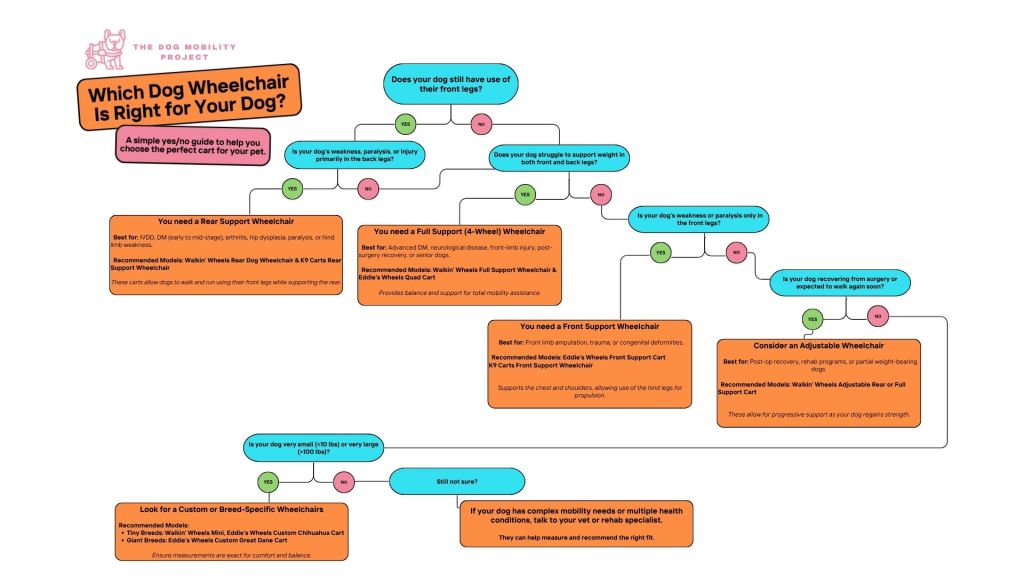
Dog Wheelchair Decision Tree: Find the Perfect Cart for Your Dog’s Needs
Choosing the right dog wheelchair can feel overwhelming, especially with so many options available. Our dog wheelchair decision tree makes it easy to find the perfect fit for your pet’s mobility needs. Just follow the simple yes-or-no questions to discover whether your dog needs a rear support, front support, or full support wheelchair—and which brands veterinarians recommend most. Perfect for first-time buyers looking for guidance on how to choose a dog wheelchair that offers comfort, safety, and freedom.


 The Dog Mobility Project
Leave a comment