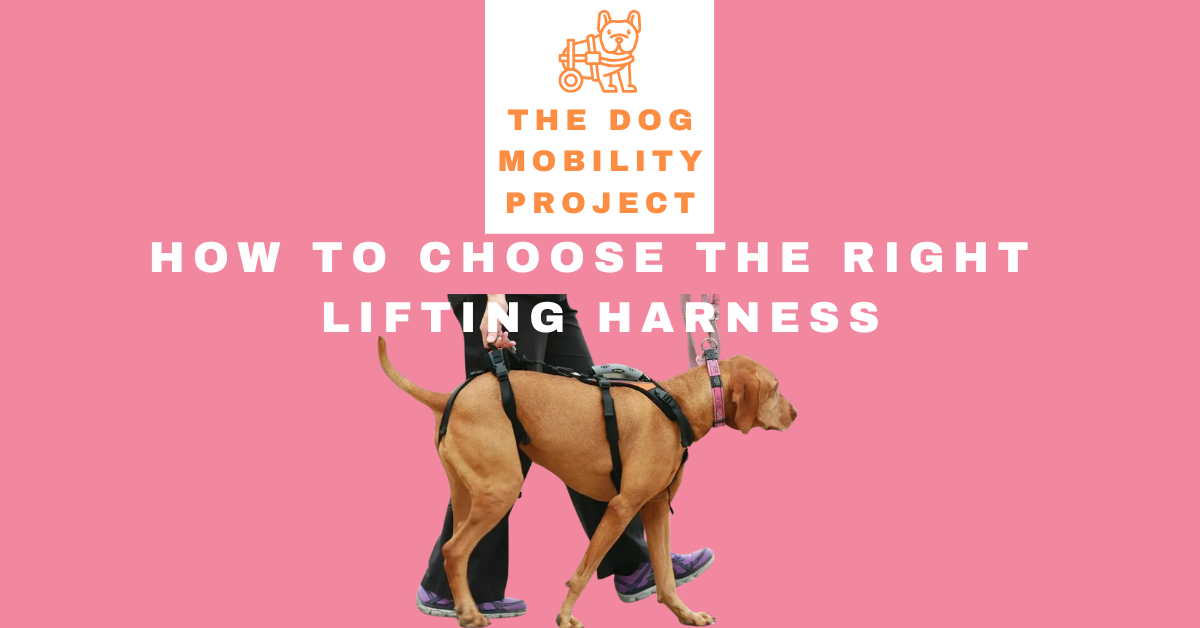
When your dog struggles with mobility—whether from age, injury, or disability—even everyday tasks can feel overwhelming. The right lifting harness can restore confidence, reduce risk of injury, and make life easier for both of you.
But not all harnesses are created equal. The key is choosing the right one based on your dog’s needs, finding the right level of support for your dog’s weak back legs, and the real-life challenges you’re facing together.
Here’s how to match the right harness to everyday challenges your dog faces.
Match the Harness to Your Dog’s Mobility Problem
Not all lifting harnesses provide the same type of support. Choosing the right style depends on where your dog is struggling.
What type of lifting harness does my dog need?
| Your Dog’s Problem | Best Starting Point |
|---|---|
| Weak back legs | Rear-support harness |
| Trouble standing up | Rear or full-body harness |
| Weak front legs | Front-support harness |
| Weakness in all four legs | Full-body harness |
| Needs occasional help walking | Support sling |
| Needs help on stairs | Rear or full-body harness |
| Recovering from surgery | Vet-approved rear or full-body support |
| Progressive mobility loss | Adjustable/modular harness |
| Cannot use back legs | Consider whether a wheelchair is more appropriate |
The best harness isn’t necessarily the one with the most features—it’s the one that supports the part of your dog’s body that needs assistance while allowing them to move as naturally as possible. If you’re unsure, ask your veterinarian or rehabilitation therapist to recommend the style that best matches your dog’s diagnosis and stage of recovery. Harness selection should be based on where support is needed, proper fit, and adjustability.
Rear Support vs. Full-Body Harness vs. Sling: Which Does Your Dog Need?
Not all dog lifting harnesses provide the same level of support. The right choice depends on where your dog is weak, how much assistance they need, and when you’ll be using the harness.
Rear-Support Harness
A rear-support harness is designed to support a dog’s hindquarters while allowing the front legs to move normally. It’s often a good choice for dogs whose front legs are still strong but who need help supporting their back end.
Rear-support harnesses may be helpful for dogs with:
- Weak back legs
- Arthritis or age-related hind-leg weakness
- Degenerative myelopathy (DM)
- Hip dysplasia
- Neurological conditions affecting the rear legs
- Difficulty standing up or maintaining balance
- Temporary weakness during recovery
The goal isn’t necessarily to lift your dog’s back legs completely off the ground. Instead, you can provide just enough assistance to reduce the weight on the hindquarters and help your dog stand, walk, or maintain their balance.
Best for: Dogs with primarily rear-leg weakness who can still walk or bear weight through their front legs.
Full-Body Lifting Harness
A full-body harness supports both the front and rear of the dog, providing more stability than a rear-only harness. This can be especially useful when weakness isn’t limited to the hind legs or when a dog needs greater assistance with balance and weight-bearing.
Full-body support may be appropriate for dogs who:
- Have weakness in both the front and back legs
- Need significant help getting up from the floor
- Are unsteady or frequently lose their balance
- Need assistance navigating stairs
- Are recovering from certain injuries or surgeries
- Have progressive mobility loss that requires increasing levels of support
Some full-body harnesses allow the front and rear sections to be used separately, which can be useful if your dog’s mobility needs change over time.
Best for: Dogs who need more substantial or evenly distributed support when standing, walking, or navigating everyday obstacles.
Dog Support Sling
A dog support sling is the simplest option. It typically wraps underneath the abdomen or hindquarters and allows you to take some weight off your dog’s legs using handles or straps.
Slings can be useful for short periods of assistance, such as helping your dog:
- Get up from the floor
- Go outside for a bathroom break
- Walk across a slippery surface
- Get through a short period of recovery
- Manage occasional weakness or fatigue
The tradeoff is that a sling generally provides less stability and control than a fitted lifting harness. It may also shift or bunch during movement, making it less practical for dogs who need frequent or sustained mobility assistance.
Best for: Occasional, short-term assistance when your dog needs a little extra help rather than ongoing support.
Which One Should You Choose?
If your dog’s back legs are weak but their front legs remain strong, a rear-support harness is often a good place to start. If your dog has more generalized weakness, significant balance problems, or needs considerable help standing and walking, a full-body harness may provide better support. For dogs who only need occasional help getting up or going outside, a simple sling may be enough.
Your dog’s needs can also change. A dog who initially needs only occasional rear support may eventually benefit from a more supportive harness or another mobility aid. If you find yourself carrying a significant portion of your dog’s weight every time they walk, it may be time to talk with your veterinarian or canine rehabilitation professional about whether a dog wheelchair or another mobility aid would provide greater independence.
🛻 Problem: Getting Your Dog Into the Car
Solution: Rear Support Harness or Full-Body Lifting Harness
A rear support harness will support directly under your dog’s hind legs. A full body lifting harness may include a rear and front harness or one harness that supports your dog’s entire torso.
- Best for: Dogs with weak back legs, arthritis, or recovering from surgery.
Recommended Brands:
- Walkin’ Lift Rear Harness – Comfortable, durable, and ideal for dogs with hind leg weakness.
- Help ‘Em Up Harness – A full-body support system with ergonomic handles and hip lift support.
- GingerLead Support Harness – Especially good for post-op dogs or those with hip dysplasia.
🐾 Problem: Helping Your Dog Up the Stairs
Solution: Full Support Harness with Dual Handles
A full support harness that lifts your dog’s entire body will offer the most control as you help your dog up and down the stairs.
- Best for: Dogs with both front and rear leg weakness or balance issues.
Recommended Brands:
- Help ‘Em Up Harness – Dual-handle system gives you full control without putting pressure on sensitive areas.
- Ruffwear Web Master Harness – Lightweight with a strong handle, great for medium support needs and outdoor use.
Tip: The Help ‘Em Up Harness includes a patented hip-lift system that makes stair support smoother and safer.
🌿 Problem: Going for Walks When Rear Legs Are Weak
Solution: Rear End Support Harness or Walking Sling
Since your dog still uses their back legs, you need a harness that offers light support. A sling that supports your dog’s midsection may be all the help you need. This style harness is intended to help your stabilize and gently support your dog, not lift them entirely off the ground.
- Best for: Short walks, potty breaks, and dogs recovering from rear leg surgery.
Recommended Brands:
- Walkin’ Support Sling – Soft fleece lining and easy to use on the go.
- GingerLead Rear Support Harness – Comes with a leash attachment and is vet-recommended.
- Kurgo Up & About Lifter – A budget-friendly sling for dogs who just need occasional help.
🛌 Problem: Helping Your Dog Rise from Lying Down
Solution: Rear End Harness
One of the most common early signs of mobility loss in senior dogs is struggling to stand up from lying on the ground. Your dog may be slow to rise or have a hard time getting their back legs underneath them. In this instance, a rear harness with a handle is the best way for you to help your dog off the ground.
- Best for: Dogs with hind limb weakness, arthritis, or recovering from knee or hip injuries and dog that can’t get up without help.
Recommended Brands:
- Help ‘Em Up Rear Harness Only – Can be purchased separately and later combined with front support.
- Walkin’ Rear Lift Harness – Lightweight and compatible with wheelchairs and front harnesses.
Pair with: Non-slip booties or traction mats to help your dog get a better grip.
🐕🦺 Problem: Full-Body Weakness or Recovery from Surgery
Solution: Full-Body Lifting Harness with Adjustable Fit
For dogs recovering from surgery that need support, always check with your veterinarian before you buy a harness. Make sure that its ok to lift your dog, movement may be extremely limited as your dog heals. Ask your veterininarian what harness they would recommend. Post-operative care is not a one size fits all – your dog’s sutures, wounds, and where they can safely be touched (lifted) will vary depending on the surgery they just had.
- Best for: Dogs recovering from surgery, with DM, IVDD, or spinal injuries.
Recommended Brands:
- Help ‘Em Up Harness – A favorite among veterinarians and rehab centers.
- Walkabout Full Support Harness – Soft neoprene body wrap with chest and rear support.
- PetSafe CareLift Support Harness – Affordable and widely available, with options for male and female dogs.
💩 Problem: Supporting Your Dog During Potty Breaks
Solution: Rear Lift Harness with Open Back Design
It’s important that the rear harness you pick has enough room for your dog to poop freely and is cut so that your dog can pee without soiling their harness. Every dog’s undercarriage is different, so you may need to try a few different harnesses before you find the one that fits your pup perfectly.
- Best for: Elderly dogs who need potty-time help without soiling their harness.
Recommended Brands:
- Walkin’ Lift Rear Harness – Designed to stay out of the way during elimination.
- GingerLead – Has a specially designed opening and padding to avoid messes.
- PetSafe Rear Lift Harness – Offers good back-end support with easy cleanup.
Final Tips for Choosing the Right Harness:
- Measure your dog carefully—weight, girth, and length matter.
- Consult your vet or rehab therapist—they can recommend the ideal type for your dog’s condition.
- Watch your dog’s body language. A good harness should provide support without causing discomfort or resistance.
- Start slow. Let your dog get used to the harness gradually and praise them often during use.
Mobility challenges don’t have to stop your dog from enjoying everyday moments. With the right harness, you can give your dog the freedom to keep moving—safely and comfortably.
Related Articles




Leave a Reply