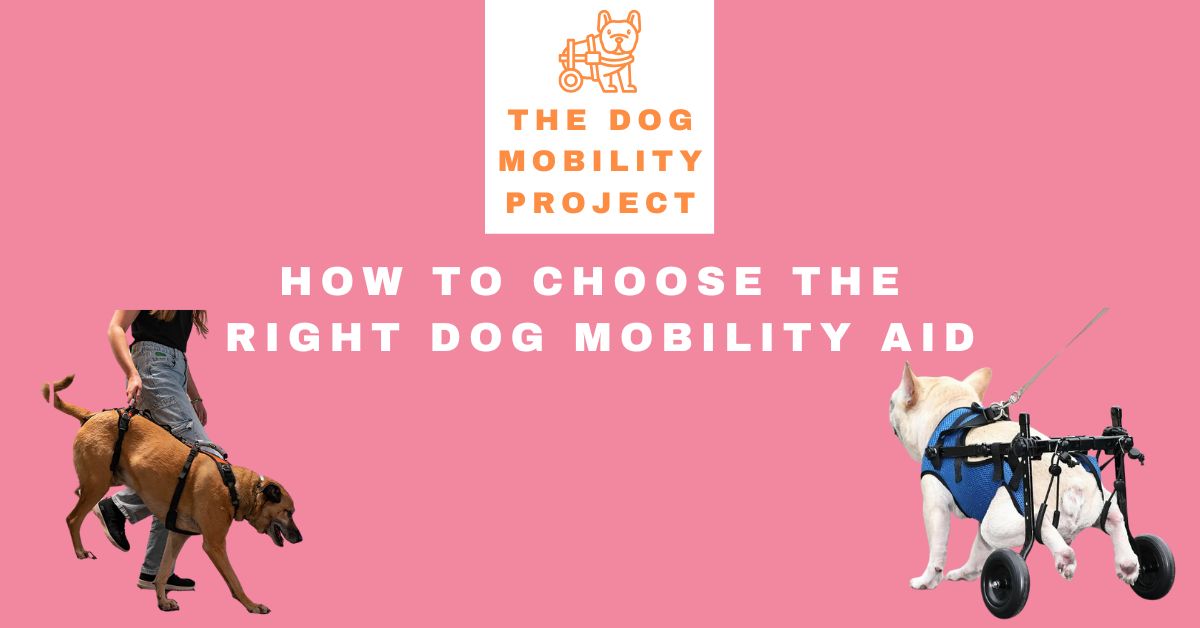
Just like people, dogs can face mobility challenges due to age, injury, or disability. The good news? When your dog starts struggling to walk, stand, climb stairs, or keep their balance, it’s natural to wonder:
What can I use to help my dog move?
There isn’t one best dog mobility aid for every dog. A dog whose paws are slipping needs different support from a dog whose back legs are too weak to stand. And a dog who needs occasional help getting up may not need the same equipment as a dog who requires support throughout an entire walk.
The best place to start isn’t with a product. It’s with what your dog can and can’t do right now.
This guide will help you compare common dog mobility aids, understand what problems they’re designed to address, and identify which options may be worth discussing with your veterinarian or rehabilitation professional.
Which Mobility Aid Does My Dog Need?
Start with the mobility problem you’re trying to solve.
| What you’re seeing | Support that may help |
|---|---|
| Slipping on smooth floors | Traction aids, rugs, appropriate paw protection |
| Dragging or scuffing paws | Paw protection; evaluation of the underlying cause |
| Knuckling | Rehabilitation strategies, paw protection, or condition-specific devices |
| Needs help standing up | Lifting or support harness |
| Weak back legs but still walking | Rear-support harness or other appropriate support |
| Needs substantial support while walking | Full-body harness or wheelchair may be considered |
| Hind legs repeatedly collapse | Wheelchair may be worth discussing |
| Paralysis with indoor scooting | Drag bag may protect the skin during appropriate supervised indoor movement |
| Difficulty with stairs or furniture | Ramp, environmental modification, or assistance |
| Needs both front and rear support | Full-body harness or four-wheel/full-support wheelchair may be considered |
This table is only a starting point.
Choosing a mobility aid is about more than selecting a product. Families also need to understand their dog’s changing needs and the options available. In our 2026 survey, 74% of caregivers reported feeling uncertain about what to do next at some point during their dog’s mobility journey. Read our research on real caregiver experiences for additional perspective.
A Perspective from a Special-Needs Rescue
JheriKeith Alkire, a special needs activist with nearly 40 years of experience caring for special-needs dogs, including dogs born with missing limbs recently shared with me her observation, that dogs born with physical differences often adapt remarkably well and may resist assistance they don’t need.
She also described how access to veterinary support changed after relocating from Kansas to New York. When it comes to veterinary care for special needs dogs…all care is not equal, it’s a highly specialized, tiny piece of the pet medical world. Her experience raises two important points: mobility support should reflect an individual dog’s abilities, and access to knowledgeable veterinary care can shape the caregiver’s experience.
Start With the Problem, Not the Product
Before buying mobility equipment, ask four questions.
1. Where Does My Dog Need Help?
Is the problem primarily in the:
- Back legs?
- Front legs?
- Paws?
- Entire body?
- Balance and coordination?
- Endurance rather than strength?
The answer can immediately narrow your options.
2. How Much Support Does My Dog Need?
There’s an important difference between a dog who needs occasional assistance and one who needs you to continuously support much of their weight.
Think about your dog’s current abilities:
- Light support: Your dog walks independently but occasionally slips, loses balance, or struggles with specific movements.
- Moderate support: Your dog can move and bear some weight but regularly needs physical assistance.
- Substantial support: Your dog can’t maintain walking without you supporting a significant portion of their body weight.
As support needs increase, the most practical mobility aid may change.
3. Is the Problem Temporary, Stable, or Progressive?
A dog recovering from surgery may need temporary assistance.
A dog with a permanent disability may need long-term adaptive equipment.
A dog with a progressive neurological condition may need equipment that can accommodate changing abilities.
You don’t need to predict exactly what your dog’s mobility will look like months from now. But knowing whether improvement, stability, or progression is expected can help guide the decision.
4. What Does My Dog Still Do Well?
Mobility aids aren’t only about what a dog can’t do.
Pay attention to what they still can do.
Can your dog:
- Move their legs voluntarily?
- Bear weight?
- Stand once you help them up?
- Walk if you support their hindquarters?
- Maintain good front-leg strength?
- Move comfortably for short distances?
- Position their paws normally?
Preserving and supporting existing abilities is an important part of choosing appropriate equipment.
1. Lifting and Support Harnesses
A dog lifting harness allows you to provide physical assistance when your dog needs help standing, balancing, walking, or managing everyday activities.
Harnesses can provide:
- Rear support
- Front support
- Full-body support
A lifting harness may make sense when your dog can still participate in movement but needs help completing it.
For example, your dog may walk once they’re standing but struggle to get their hindquarters off the floor.
Or they may walk independently but lose their balance during bathroom breaks.
That’s different from a dog who requires continuous support throughout an entire walk.
Consider a lifting harness if:
- Your dog struggles to stand
- Their back legs are weak
- They need occasional balance assistance
- They need help during bathroom breaks
- They require controlled assistance during an appropriate recovery plan
- You need to provide short periods of physical support
We’ve separated the two biggest harness questions into dedicated guides:
If you’re deciding which type to buy, read How to Choose the Right Dog Lifting Harness.
If you already have one and need help using it, read How to Help a Dog Stand Up and Walk With a Support Harness.
2. Dog Wheelchairs
A dog wheelchair, sometimes called a mobility cart, provides more sustained support while a dog moves.
Rear-support wheelchairs primarily support the hindquarters, while full-support or four-wheel carts can provide additional assistance to dogs who need support at both ends.
One of the biggest misconceptions about wheelchairs is that they’re only for dogs who are completely paralyzed.
They’re not.
Depending on the individual dog and veterinary guidance, a wheelchair may be considered while a dog still has some ability to move their legs.
A wheelchair may be worth discussing if:
- Your dog’s hind legs repeatedly collapse
- Walking requires continuous rear support
- Your dog has paralysis or significant weakness
- They still want to move but can’t maintain mobility independently
- Paw dragging is making walking difficult
- Their mobility condition is progressing
- A veterinarian or rehabilitation professional recommends supported exercise or mobility
Wheelchairs can also be used differently depending on the dog. Some dogs need one long term, while others may use one during recovery or rehabilitation.
If you’re wondering whether your dog has reached this point, read our Dog Wheelchair Guide: Everything You Need to Know.
Harness or Wheelchair: How Do I Decide?
This is one of the most common mobility-aid decisions.
A simple way to think about the difference is:
A harness relies heavily on you for support. A wheelchair provides ongoing mechanical support while your dog moves.
A harness may be enough when your dog needs help with specific activities or short periods of movement.
A wheelchair may become more practical when you’re supporting a substantial portion of your dog’s weight throughout a walk.
And some dogs use both.
For example, a dog might use a harness to get outside and a wheelchair for a longer walk.
The decision isn’t necessarily: harness OR wheelchair.
It’s: What support does my dog need for this activity?
For a deeper comparison, read Dog Wheelchair vs. Harness: Which Mobility Aid Is Right for Your Dog?.
3. Paw Protection
Sometimes the immediate mobility problem isn’t supporting the dog’s body. It’s protecting their feet.
Dogs with neurological weakness or altered paw placement may drag or scuff the tops of their paws while walking.
Repeated dragging can damage:
- Nails
- Paw skin
- The tops of the toes
- Other areas repeatedly contacting the ground
Protective dog boots may help shield the paw from abrasion.
But it’s important to understand what boots don’t do.
A boot can protect a dragging paw, but it doesn’t explain or treat why the paw is dragging.
New or worsening paw dragging should be evaluated.
If you’re seeing worn nails, scuffed paws, or hearing a nail scrape against the ground, read Why Is My Dog Dragging Their Paws?.
4. Traction Aids
Sometimes a dog’s mobility looks dramatically worse simply because they can’t get enough grip.
Hardwood, tile, laminate, and other smooth surfaces can be challenging for dogs with:
- Arthritis
- Weakness
- Poor balance
- Reduced coordination
- Pain
- Difficulty positioning their paws
Before assuming your dog needs major mobility equipment, look at the floor.
If your dog struggles on hardwood but moves significantly better on carpet, traction is probably contributing to what you’re seeing.
Options may include:
- Non-slip rugs
- Carpet runners
- Yoga mats
- Appropriate traction products
- Certain dog boots, if your dog tolerates them and they improve rather than interfere with movement
Environmental changes can sometimes be just as important as wearable equipment.
Learn more in Why Is My Dog Slipping? 10 Common Causes and How to Help.
5. Ramps and Environmental Support
Not every mobility aid needs to attach to your dog.
Sometimes the best solution is changing the environment.
A ramp may reduce the need to jump into a vehicle or onto furniture. Blocking unsafe stairs may prevent falls. Non-slip flooring can make getting up easier.
Other useful modifications may include:
- Ramps
- Non-slip flooring
- Carpet runners
- Gates
- Supportive bedding
- Raised or repositioned food and water bowls when appropriate
- Rearranging furniture to create wider, clearer walking paths
The goal is to make the home work better for the way your dog moves now.
6. Drag Bags
A drag bag is a protective garment designed primarily for dogs who move around indoors by scooting or dragging their hindquarters.
Its main purpose is protection.
It may help shield the dog’s:
- Legs
- Skin
- Underside
from repeated friction against indoor surfaces.
A drag bag isn’t a substitute for a wheelchair, rehabilitation, or veterinary treatment. It’s a specialized tool that may be useful for certain dogs during appropriate supervised indoor activity.
Dogs who drag themselves can develop abrasions and pressure-related skin problems, so their skin should be checked frequently.
What About No-Knuckling Devices?
Knuckling means the paw isn’t being placed normally on the ground. It can occur with neurological or orthopedic problems and deserves veterinary evaluation, particularly when it’s new or worsening.
Some rehabilitation devices are designed to provide sensory input or encourage paw placement during specific, supervised exercises.
That doesn’t mean every dog who knuckles should wear a corrective device throughout the day.
The appropriate strategy depends on why the dog is knuckling.
If you’re seeing this movement, start with Dog Knuckling: What It Means and What to Do.
What About Braces, Orthotics, and Prosthetics?
These devices deserve their own category because they’re different from general mobility aids.
Orthotics and braces may be designed to support or stabilize a specific joint or limb.
Prosthetics may replace part of a missing limb in dogs who are appropriate candidates.
These aren’t products I would choose based on diagnosis alone.
Fit, anatomy, biomechanics, skin health, the dog’s remaining limb function, and the specific condition all matter.
If you’re considering an orthotic or prosthetic, work with veterinary professionals experienced in evaluating and fitting these devices.
Should I Ask About Veterinary Rehabilitation?
Yes, particularly if you’re unsure how much your dog should be moving or what kind of support is appropriate.
Veterinary rehabilitation can involve individualized approaches to mobility, strength, balance, pain, and recovery. AAHA describes rehabilitation as using targeted therapies and exercises based on the individual patient’s needs. Learn about veterinary physical rehabilitation from AAHA
A rehabilitation professional may also help determine whether your dog needs equipment primarily for protection, balance, weight support, exercise, or everyday independence.
Don’t Choose a Mobility Aid Based on Diagnosis Alone
This is one of the most important things to understand.
Two dogs with the same condition may need completely different mobility aids.
Two dogs with arthritis might look like this:
Dog A: Walks well but occasionally slips on hardwood.
Dog B: Has significant hind-leg weakness and needs help getting up.
Giving both dogs the same equipment simply because they both have arthritis wouldn’t make sense.
The same applies to IVDD, degenerative myelopathy, hip dysplasia, neurological disease, injury, and other mobility conditions.
Choose support based on your dog’s current abilities as well as their diagnosis.
Can Using a Mobility Aid Make My Dog Weaker?
Not automatically.
The effect depends on the dog’s condition, the equipment, how it’s used, and the dog’s rehabilitation or activity plan.
A mobility aid shouldn’t automatically mean doing all the work for your dog.
For some dogs, appropriate support allows them to participate in movement they otherwise couldn’t perform safely. For others, activity needs to be restricted because of surgery, injury, pain, or another medical condition.
That’s why there’s no universal rule that a dog should simply “walk more” once they have mobility equipment.
Follow the activity recommendations appropriate for your dog’s condition.
Does My Dog Need More Than One Mobility Aid?
Possibly.
Mobility aids don’t have to be mutually exclusive.
One dog might use:
- Rugs for traction inside
- A lifting harness for bathroom breaks
- Boots to protect dragging paws
- A wheelchair for longer outdoor activity
Another dog may need nothing more than a runner over a slippery hallway.
The goal isn’t to accumulate equipment.
It’s to solve specific mobility problems.
When Should I Reevaluate My Dog’s Mobility Aid?
Your dog’s needs can change.
Reassess their equipment if you notice:
- More frequent falls
- Increasing weakness
- New paw dragging
- Difficulty standing that wasn’t present before
- Shorter walking tolerance
- New front-leg weakness
- A harness or wheelchair no longer fitting properly
- Skin irritation or pressure areas
- Your dog requiring substantially more assistance than before
A mobility aid that worked six months ago may no longer be the best solution today.
New or rapidly worsening mobility changes should also prompt veterinary evaluation rather than simply upgrading the equipment.
Frequently Asked Questions
What is the best mobility aid for a dog with weak back legs?
It depends on how much support the dog needs. A dog with mild weakness may benefit from improved traction or a rear-support harness. A dog requiring substantial ongoing support may need a wheelchair or another solution.
Start by identifying the cause and severity of the weakness.
What can I use to help my dog walk?
Depending on the problem, options may include a lifting harness, wheelchair, traction aid, paw protection, ramp, or environmental modification.
The best option depends on why walking has become difficult.
Does my dog need a harness or wheelchair?
A harness may be appropriate when your dog can still walk but needs occasional physical assistance. A wheelchair may be worth considering when sustained support is needed throughout movement.
Some dogs benefit from both for different activities.
Can a dog use a wheelchair if they can still walk?
In some cases, yes.
A dog doesn’t necessarily have to lose all walking ability before a wheelchair is considered. The decision depends on the underlying condition, strength, mobility goals, and veterinary or rehabilitation recommendations.
What mobility aid helps a dog that drags its paws?
Paw protection may help prevent abrasions, but it’s important to determine why the paw is dragging. Depending on the cause, rehabilitation, a mobility aid, or another treatment may also be appropriate.
What if I don’t know what mobility problem my dog has?
Start by documenting what you’re seeing.
Take a safe video of your dog walking, note when the problem happens, and pay attention to surfaces or activities that make it better or worse.
You can also use the Dog Mobility Symptom Finder to help identify the movement you’re seeing before discussing it with your veterinarian.
The Right Mobility Aid Starts With the Right Question
When your dog begins struggling with mobility, it’s easy to jump straight to:
What should I buy?
A better question is: What is my dog struggling to do, and what kind of support would make that activity safer or easier?
Sometimes the answer is a wheelchair.
Sometimes it’s a lifting harness.
Sometimes it’s paw protection, a ramp, rehabilitation, or simply putting a non-slip runner across the kitchen floor.
And sometimes a sudden mobility change means the next step isn’t equipment at all. It’s veterinary care.
The goal of a mobility aid isn’t simply to compensate for what your dog has lost.
It’s to provide the right amount of support for the abilities they still have, helping them participate in everyday life as safely and comfortably as possible.

Related Articles
This article provides educational information and isn’t a substitute for veterinary diagnosis or treatment.





Leave a Reply