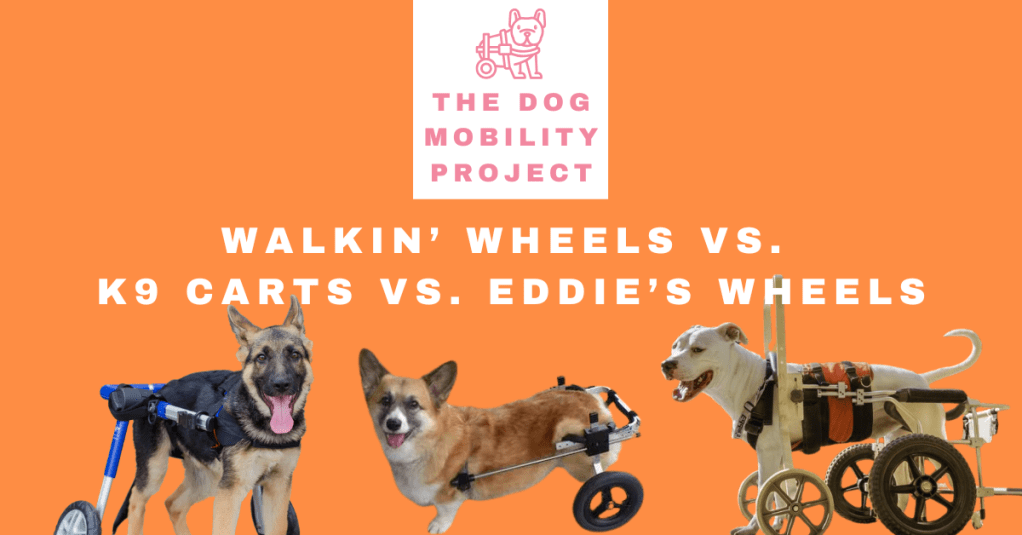
Choosing a wheelchair for your dog can feel overwhelming—fast. Each brand has passionate fans, different build philosophies, and real trade-offs. You want to choose the “right” wheelchair, but how do you decide? There are so many options that the buying process is not an easy one. This guide gives you an honest, side-by-side look at Walkin’ Wheels, K9 Carts, and Eddie’s Wheels, plus practical advice to help you pick the best fit for your dog, lifestyle, and budget.
Quick note: A great cart doesn’t “fix” a poor fit. Accurate measurements, the right configuration (rear, front, or quad), and gradual acclimation matter as much as brand choice. When in doubt, loop in your vet or a rehab professional (CCRT/CCRP).
Wheelchair Brand Comparison
| Feature | Walkin’ Wheels | K9 Carts | Eddie’s Wheels |
| Core Design | Adjustable/modular (“off-the-shelf”) | Semi-custom (size ranges, built to measurements) | Fully custom (built to your dog) |
| Typical Lead Time | Ships quickly (often same/next business day) | Short-to-moderate (built to order) | Moderate (fully custom build) |
| Adjustability After Purchase | High (width/height/length) | Some (within size class) | Limited (custom to one dog) |
| Materials | Lightweight aluminum; foam/air tires | Aluminum/stainless options; sturdy build | Heavy-duty aluminum; robust fasteners |
| Configurations | Rear, Front, Quad | Rear, Front, Quad | Rear, Front, Quad |
| Ease of Resale | High (adjustable) | Moderate | Low (custom to your dog) |
| Price | $$ (budget-friendly to mid) | $$–$$$ (mid) | $$$ (premium/custom) |
| Best For | First-time buyers, growing dogs, rescues, “try it now” | Owners wanting build-to-measure without full custom | Complex anatomies, long-term users, performance fit |
Brand-by-Brand: Honest Pros & Cons
Walkin’ Wheels (Walkin’ Pets)
What it is: A highly adjustable, ready-to-ship cart system designed to fit many dogs quickly. Cart frame is available in different colors to match your dog’s personality. Great for trying out a wheelchair without committing to a permanent custom build.
Pros
- Fast access & easy setup. Ships quickly; straightforward assembly for most pet parents. Easily transported, larger wheelchairs fold to fit in the trunk of your car.
- Adjustable in multiple dimensions. Height, length, and width adjust with a few clicks of a push button to adjust the fit as your dog changes weight, strength, or coat.
- Budget-friendlier entry point. Useful for short-term recovery, hospice, rescues, or when you’re unsure how your dog will take to a cart.
- Resale and re-use friendly. Because it adjusts, it’s easier to pass along, donate, or resell.
- Modular parts & accessories. Swappable wheels, front kits (for quad), and harness options. Easily converts from a rear wheelchair to a full support wheelchair.
- Replacement parts are easily purchased as needed, ensuring the longevity of the cart and the ability to keep it functional for longer.
Cons
- Not precision-built to one dog. A good adjustable fit can be excellent, but custom can edge it for unique anatomies or super specific health needs.
- More knobs = more variables. New users sometimes need a little trial-and-error to nail the “sweet spot.”
- Perceived stability vs. custom. For extreme activity or very asymmetrical bodies, fully custom frames may feel more “locked in.”
Best fit if: You want speed, affordability, flexibility for changes (weight, muscle atrophy, rehab progress), or plan to donate/resell later. Great first chair for most families. A reliable option that once it’s adjusted is easy to use and transport anywhere.
K9 Carts
What it is: A long-standing brand with a semi-custom approach—built to your dog’s measurements within specific size families.
Pros
- Built to your dog’s measurements. Offers a more tailored fit than off-the-shelf without the full custom complexity.
- Proven designs with clinical heritage, invented and used by Veterinarians. Many rehab pros know and trust their frames.
- Solid materials, repairable. Durable hardware, with parts support.
Cons
- Less adjustability after delivery. You’ll get some room to tweak, but not the range of a fully modular system.
- Lead time & returns can be stricter. Because it’s built to order, changes/returns may be more limited than mass-produced systems.
- Resale/transfer is harder. Because it’s tied to your dog’s proportions, it may not fit another dog without work.
Best fit if: Your dog has fairly typical proportions, you want closer-to-custom fit than a universal cart, and you’re okay with some lead time.
Eddie’s Wheels
What it is: A premium, fully custom wheelchair built to detailed measurements, often recommended for complex cases or long-term (and very active) users.
Pros
- Precision fit for complex anatomies. Great for dogs with limb length discrepancies, spinal deformities, amputations, or specific posture needs.
- Excellent stability & performance. Many dogs move with a natural gait once fit is dialed in.
- High durability. Robust frames built for heavy, strong, or very active dogs.
Cons
- Premium price & lead time. Custom engineering takes time and money.
- Limited adjustability later. If your dog’s body changes significantly (muscle loss/gain, weight change), you may need refitting or updates.
- It may be harder to fit into the back of your car for transport.
- Resale is tough. Custom specs rarely match another dog.
Best fit if: Your dog is a long-term or complex user, you want the best possible performance fit, and you’re ready for a precise measurement process and premium investment.
How to Choose: A Practical Framework
Use these questions to narrow your pick fast:
- How stable is your dog’s condition?
- Changing or uncertain (recovering IVDD, DM progression, weight shifts, growing pups): Start with Walkin’ Wheels. High adjustability saves you from refitting costs and adapts to your dog’s changing needs.
- Stable proportions and activity needs: K9 Carts offers a good balance of fit and value.
- Complex/long-term/performance needs: Eddie’s Wheels for precision and stability.
- How soon do you need the chair?
- This week: Walkin’ Wheels (fastest to your door).
- Can wait a bit: K9 Carts or Eddie’s Wheels.
- What’s your budget and total plan?
- Entry budget / trying a cart / fosters & rescues: Walkin’ Wheels.
- Mid-range with better match to measurements: K9 Carts.
- Premium, custom, long horizon: Eddie’s Wheels.
- Will you want to resell, donate, or reuse?
- Yes: Walkin’ Wheels (most transferable).
- Maybe: K9 Carts (some limitation).
- Unlikely: Eddie’s Wheels (custom to your dog).
- Handling & terrain:
- Mostly indoors/flat surfaces: Any brand works—prioritize fit and ease of use.
- Outdoors/uneven ground or very active dogs: A dialed-in custom (Eddie’s Wheels) or a well-tuned K9 Carts can feel more “planted.” Walkin’ Wheels with the right wheel/tire setup also does well.
Fit & Comfort: What Matters Most (Regardless of Brand)
- Correct pelvic support height. Rear paws should just graze the ground for dogs with partial mobility; fully paralyzed dogs may need stirrups to prevent dragging.
- Weight balance. Avoid pitching the front shoulders forward (too much weight on the forelimbs) or lifting the rear too high.
- Spine alignment. The cart should allow a neutral topline—not arched or swayed.
- Harness compatibility. A comfortable, well-padded harness prevents rubs and hotspots.
- Wheel size to terrain. Larger wheels roll easier over grass, gravel, or snow.
- Gradual acclimation. Start with short, positive sessions. Reward movement, not just standing.
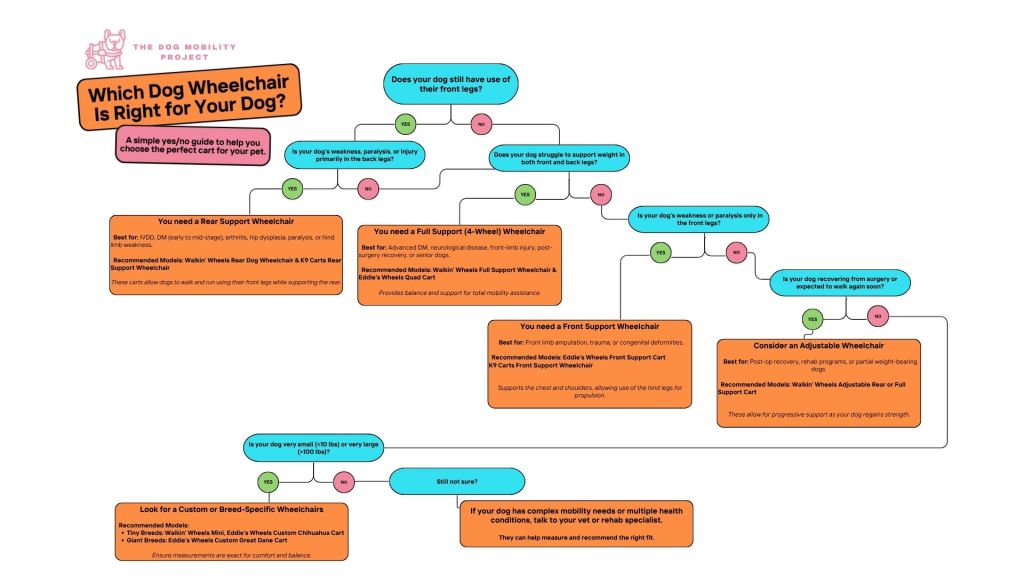
Rear, Front, or Quad?
- Rear carts help hind-end weakness or paralysis (IVDD, DM, hip dysplasia, arthritis).
- Front carts are for forelimb deficits (nerve damage, congenital issues).
- Quad carts support all four limbs—useful for generalized weakness, cerebellar issues, or tri-limb compromise.
Ask your vet/rehab pro which frame best protects joints and encourages safe movement.
Measuring Tips (so your cart actually fits)
- Measure on level ground with your dog standing neutrally—don’t measure while sitting or slouching.
- Get a helper to keep your dog square and calm.
- Follow each brand’s specific measurement guide (they differ on where to start/stop a tape).
- Double-check critical numbers (height at the hip or shoulder, length from shoulder to rump, width).
- Photograph your dog from the side & front when you submit measurements; photos help support teams spot issues.
Real-World Scenarios
- “I need a chair fast—my dog just lost hind strength.”
Start with Walkin’ Wheels to get moving now. If the condition stabilizes and you want a performance upgrade later, you can reassess. - “My corgi has IVDD and unusual proportions.”
If adjustables fit well, Walkin’ Wheels can work; if you struggle to balance the frame or keep a neutral topline, a custom Eddie’s Wheels can solve proportion quirks. - “We hike on uneven trails; my shepherd is strong up top but hind-weak.”
Eddie’s Wheels (custom balance, large wheels) or a well-fitted K9 Carts. If you start with Walkin’ Wheels, choose larger wheels and take time dialing in height/length. - “Budget is tight—we just want our senior pug to enjoy the yard again.”
Walkin’ Wheels offers great value and easy adjustments as needs change.
Support, Service, and Updates to Ask About
- Trial & return policy: Especially if you’re new to carts.
- Spare parts availability: Wheels, harnesses, struts, fasteners.
- Customer support hours & expertise: Can they review photos/video to help you fine-tune fit?
- Warranty & repairability: What’s covered and for how long?
- Upgrade path: Can you add a front kit later to make a quad? Swap wheel sizes?
Bottom Line
- Pick Walkin’ Wheels if you want speed, flexibility, and strong value—excellent for first-time users, rescues, hospice, and evolving conditions.
- Pick K9 Carts if you want a closer-to-custom fit with measured builds and you’re okay with less adjustability after delivery.
- Pick Eddie’s Wheels if you need precision engineering for complex cases or long-term, highly active use—and you’re ready to invest in custom.
Need Help Deciding?
If you share your dog’s breed, weight, diagnosis, limb strength (front/back), and a couple photos from the side and front, I can suggest the ideal configuration and a measurement checklist tailored to your pup—so you buy once, fit right, and get rolling with confidence.




 The Dog Mobility Project
Leave a reply to IVDD Treatment Options: How to Choose the Right Path for Your Dog – The Dog Mobility Project Cancel reply