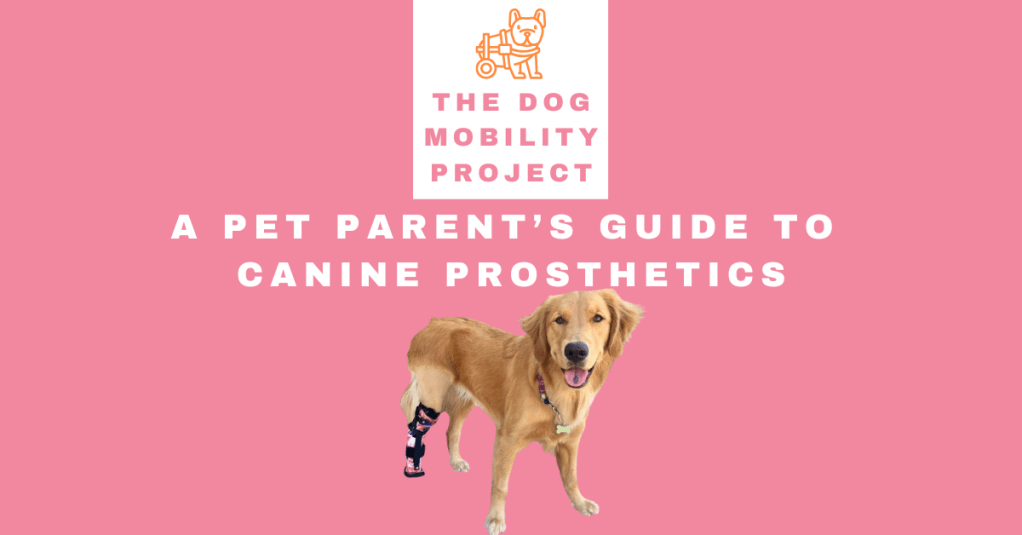
When a dog loses a limb—or is at risk of losing one due to injury, illness, or birth defect—it can be heartbreaking. But thanks to advancements in veterinary medicine and animal mobility technology, amputation doesn’t have to be the end of your dog’s active life. In many cases, it’s just the beginning of a new chapter—one filled with resilience, adaptation, and sometimes, a prosthetic leg.
If you’re exploring the idea of a prosthetic for your dog, whether you’re pre- or post-surgery, you’re not alone. At The Dog Mobility Project, we aim to empower you with the knowledge, resources, and support you need to make the best decision for your dog’s future.
Understanding Dog Prosthetics
A dog prosthetic is a custom-fitted device that replaces a missing limb or part of a limb. These devices are designed to support your dog’s mobility, balance, and overall comfort. They’re most commonly used in dogs who have undergone partial limb amputations—meaning some of the limb structure remains, allowing a prosthetic to be fitted and functionally supported.
There are several types of prosthetics available:
- Front limb prosthetics: Designed for partial forelimb amputations, usually attaches to the residual stump of the dog’s upper front leg.
- Rear limb prosthetics: Used for dogs missing part of their hind leg.
- Paw prosthetics: Created for dogs missing only a foot or paw pad.
- Full-leg prosthetics: Rare but becoming increasingly normalized for front limb amputations, especially with the advancement of 3D scanning and fabrication. This style of prosthetic often features a cage-style harness that straps to a dog’s chest to help position the full leg prosthetic.
If you’re considering a prosthetic after surgery, consult with your veterinarian beforehand. There are no standards for how much of a stump should be left after an amputation, and most dogs will need a big enough stump so that the prosthetic attaches comfortably.
Is a Prosthetic Right for Your Dog?
Not every amputee dog is a candidate for a prosthetic, and not every dog needs one to live a full and active life. Many dogs thrive as tripods (three-legged dogs), especially when they’re younger, smaller, or have a healthy remaining limb structure. However, prosthetics can be especially helpful in:
- Large or giant breed dogs, who may struggle with weight distribution on three legs.
- Dogs with orthopedic conditions or arthritis in the remaining limbs.
- Active dogs that want to maintain high energy lifestyles.
- Dogs with partial amputations, where enough limb remains for a prosthesis to attach securely.
- Dogs who are losing a limb due to injury, cancer, or deformity and whose families want to explore options before amputation.
Many dogs missing a leg can get around just fine without a prosthetic and may not need one. However, be aware that your dog is likely to place more weight and strain on the remaining healthy leg. As a tripod dog gets older, they may develop arthritis or joint pain that makes it harder to walk around without assistance. It’s pretty common for tripod dogs to need a wheelchair later in life.
Before deciding on a prosthetic, consult with a veterinary specialist who has experience in animal orthotics and prosthetics (AOP). They’ll help determine if your dog is a candidate and guide you through the process.
Before Surgery: Ask About Limb-Sparing Options
If your dog hasn’t had surgery yet, now is the time to talk to your veterinarian about preserving enough of the limb to allow for a prosthetic later. In traditional amputations, the entire limb is often removed to avoid complications—but if prosthetic use is a consideration, a partial amputation may be an option.
Ask your vet:
- Can part of the limb be spared safely?
- Is there a veterinary surgeon experienced in prosthetic-friendly amputations?
- What are the long-term implications of preserving a partial limb?
It’s essential to balance your dog’s safety and comfort with the potential for a prosthetic. In some cases, a full amputation is still the best option—but it never hurts to explore every path.
What to Expect: The Process of Getting a Canine Prosthetic
Once your dog is ready and approved for a prosthetic, here’s what the process generally looks like:
- Initial Evaluation: A veterinary specialist assesses your dog’s mobility, health, and limb condition.
- Casting or 3D Scanning: The limb is measured or scanned for a custom fit.
- Fabrication: The prosthetic is built—usually from lightweight, durable materials.
- Fitting & Adjustment: The prosthesis is fitted and fine-tuned to ensure comfort and functionality.
- Rehabilitation: Your dog may need physical therapy to build strength, confidence, and coordination.
- Follow-Up: Regular check-ins to adjust or replace the prosthesis as your dog grows or changes.
Pros and Cons of Dog Prosthetics
Pros:
- Improved mobility and balance
- Reduced strain on remaining limbs
- Increased comfort for some dogs
- Customizable to your dog’s lifestyle
Cons:
- Not all dogs adapt easily
- Time and cost involved in fitting and maintenance
- Requires owner commitment to training and rehab
- Potential skin irritation or fit issues
Alternatives to Consider
If your dog isn’t a candidate for a prosthetic, there are still plenty of options to support their mobility:
- Dog wheelchairs for rear or front limb support
- Support harnesses to help with stairs and uneven terrain
- Orthotic braces to stabilize weakened joints
- Home modifications like ramps or non-slip mats
Empowered, Not Limited
Dogs are incredibly resilient. With or without all four legs, they’re often more concerned with chasing a ball than worrying about what they’ve lost. But as pet parents, we have the responsibility—and the privilege—to explore all the ways we can support them.
Whether you move forward with a prosthetic or take another path, know this: you’re doing right by your dog simply by asking the questions, exploring the options, and showing up with love.
Need Help?
At The Dog Mobility Project, we’re here to support you every step of the way. Reach out for guidance, connect with other pet parents, and explore our educational resources and real-life success stories. Because when a dog is given the chance to move again, no matter how many legs they have, it’s nothing short of magic.

 The Dog Mobility Project
Leave a comment